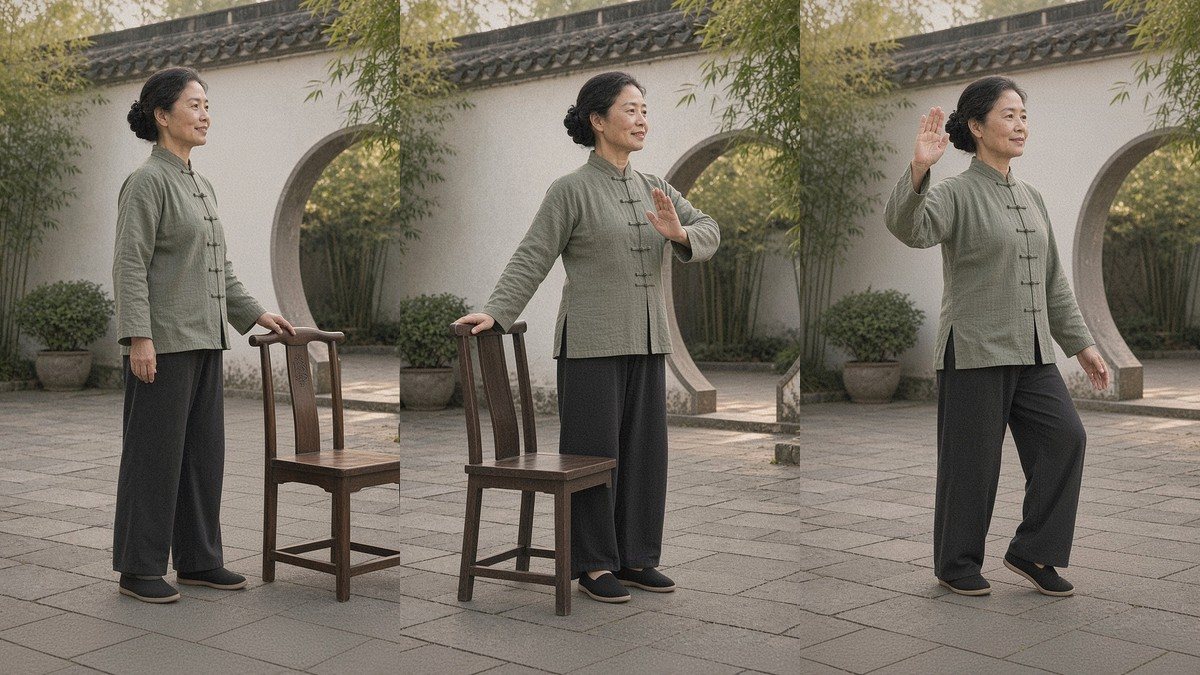
Tai chi is often called the perfect exercise for older adults, and there is a good reason. It is slow, it is gentle on the joints, and you can do it sitting, holding a chair or standing on your own.
But if you are in your late 60s, 70s or 80s, you probably have real questions first. Is it safe for me? What if my balance is not good? What actually happens in a class?
This guide answers those questions, helps you choose the right way to start and gives you 5 easy supported moves you can try at home today.
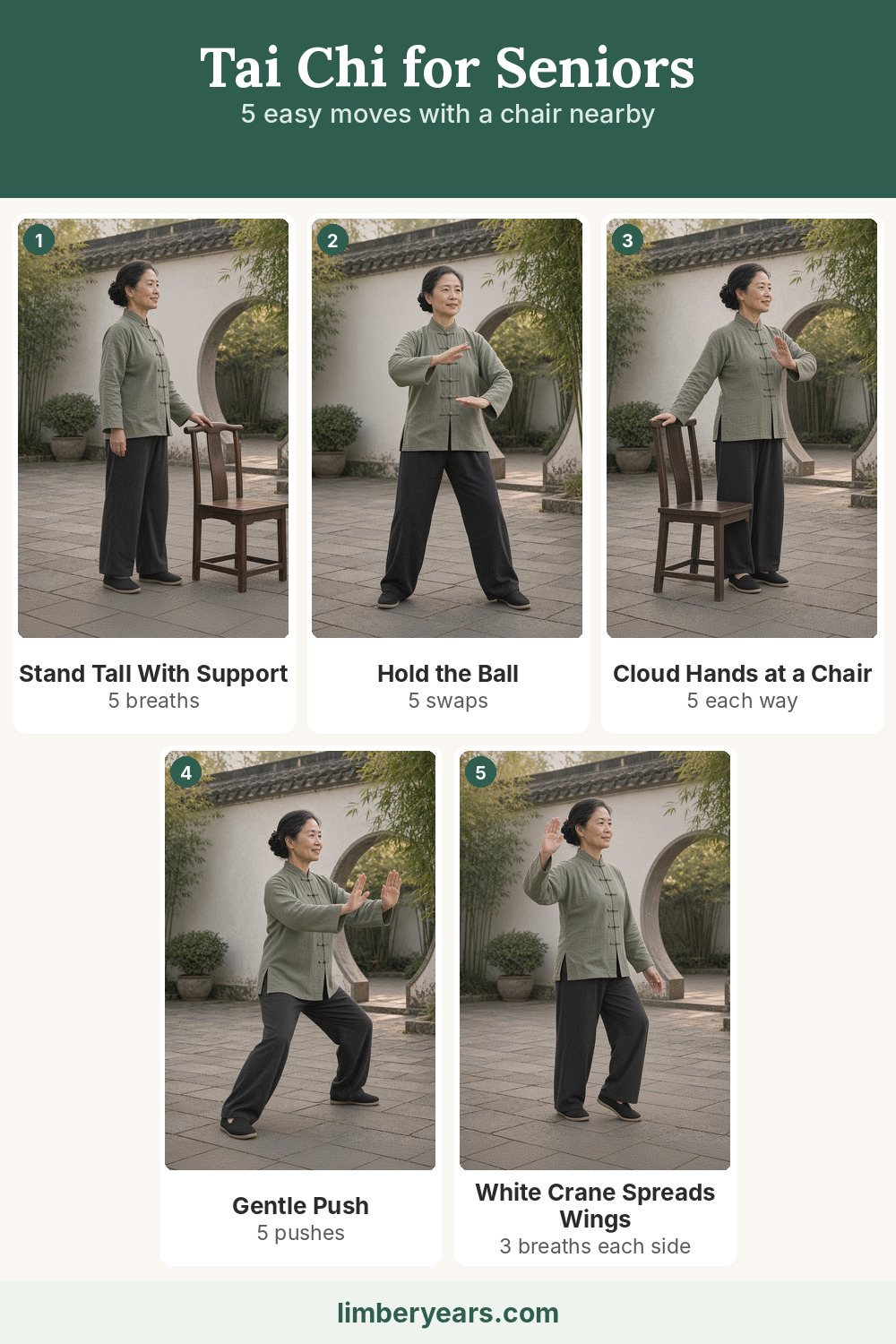
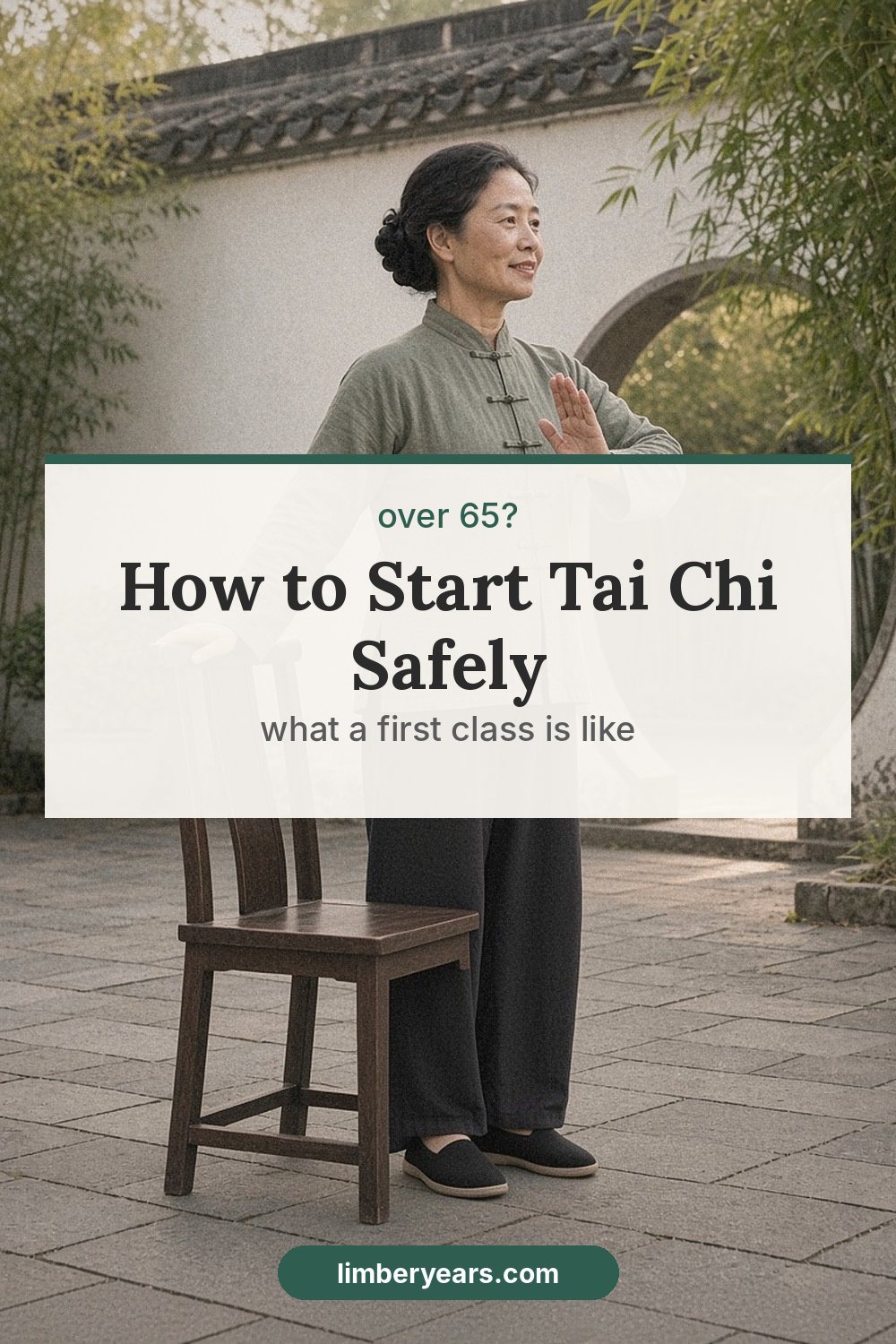
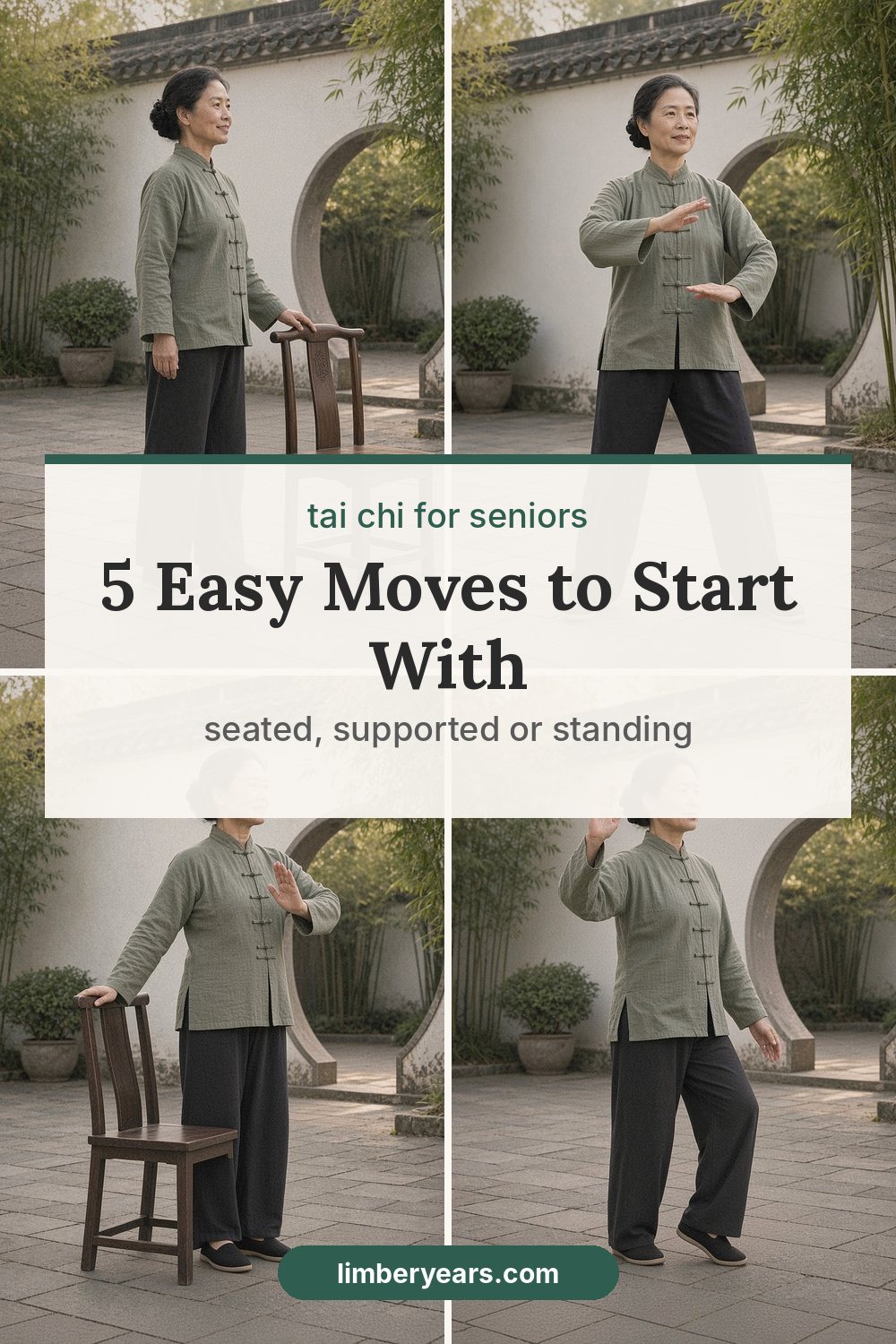
Save this chart to Pinterest or print it out and keep it near your favorite chair. Photos on this site are made with AI to show each move clearly.
Key takeaways
- Tai chi is one of the safest forms of exercise, and you do not need to be fit to start.
- You can do it seated, holding a chair or free standing. Start wherever feels safe.
- A class or a good video helps a lot. Instructors do not need a licence, so ask about their experience.
- Check with your doctor first if you have balance problems, joint replacements or take medicines that make you dizzy.
Before you start
- Use a sturdy chair without wheels, placed where it cannot slide.
- Wear flat, flexible shoes with a good grip, not slippers or socks on a smooth floor.
- Clear rugs and clutter from the space around you.
- Have a glass of water nearby.
- Stop if you feel pain, dizziness, chest pain or shortness of breath.
Is tai chi safe for seniors?
For most older adults, yes. Harvard Health says:
Tai chi is very safe, and no fancy equipment is needed, so it’s easy to get started.
Harvard Health: The health benefits of tai chi
The National Center for Complementary and Integrative Health (NCCIH) agrees that “Tai chi appears to be safe.” It reports that in a review of 24 studies, problems were no more common in people doing tai chi than in people doing other activities or no exercise at all.
And you do not have to be fit to begin. Harvard Health says “you can get started even if you aren’t in top shape or the best of health.”
Seated, supported or standing: which should you choose?
| Way to start | Good if you | Where to begin |
|---|---|---|
| Seated | You use a walker or cane, feel unsteady standing, or tire quickly | Our chair tai chi guide |
| Holding a chair | You can stand for 10 minutes but like something to hold | The 5 moves on this page |
| Free standing | You feel steady on your feet and walk without help | Our tai chi for beginners guide |
You can move between them. Many people start seated, then stand holding a chair after a few weeks, then let go for some moves.
Tai chi in your 70s and 80s
- Keep your steps short and your stance narrow. A small move done well is better than a big one that wobbles.
- Bend your knees only a little. Tai chi photos often show deep stances, but you do not need them.
- Keep a chair beside you for any move where weight shifts onto one leg.
- Practise for 5 to 10 minutes at a time. Two short sessions are better than one long one.
- If you have had a hip or knee replaced, avoid twisting on the new joint and ask your surgeon or physical therapist which moves are fine.
- If you have osteoporosis, keep your back tall and skip any move that asks you to bend forward or twist hard.
What a first class is like
Most classes start with a gentle warm up. Harvard Health describes it this way: “Easy motions, such as shoulder circles, turning the head from side to side, or rocking back and forth, help you to loosen your muscles and joints and focus on your breath and body.”
Then the teacher shows a few moves, slowly, and you copy. Nobody expects you to remember them. Classes often last about an hour, but you can sit down and rest at any point. Many beginner classes for older adults are seated or have chairs ready.
Wear loose clothes and flat shoes. You do not need a mat or any equipment.
The 5 easy moves at a glance
| # | Move | Works on | How much |
|---|---|---|---|
| 1 | Stand Tall With Support | Posture and steadiness | 5 slow breaths |
| 2 | Hold the Ball | Arms and shoulders | 5 slow swaps |
| 3 | Cloud Hands at a Chair | Waist and balance | 5 slow turns each way, then switch hands |
| 4 | Gentle Push | Legs and arms | 5 slow pushes, then switch feet |
| 5 | White Crane Spreads Wings | Balance | Hold for 3 breaths, 2 times each side |
1. Stand Tall With Support
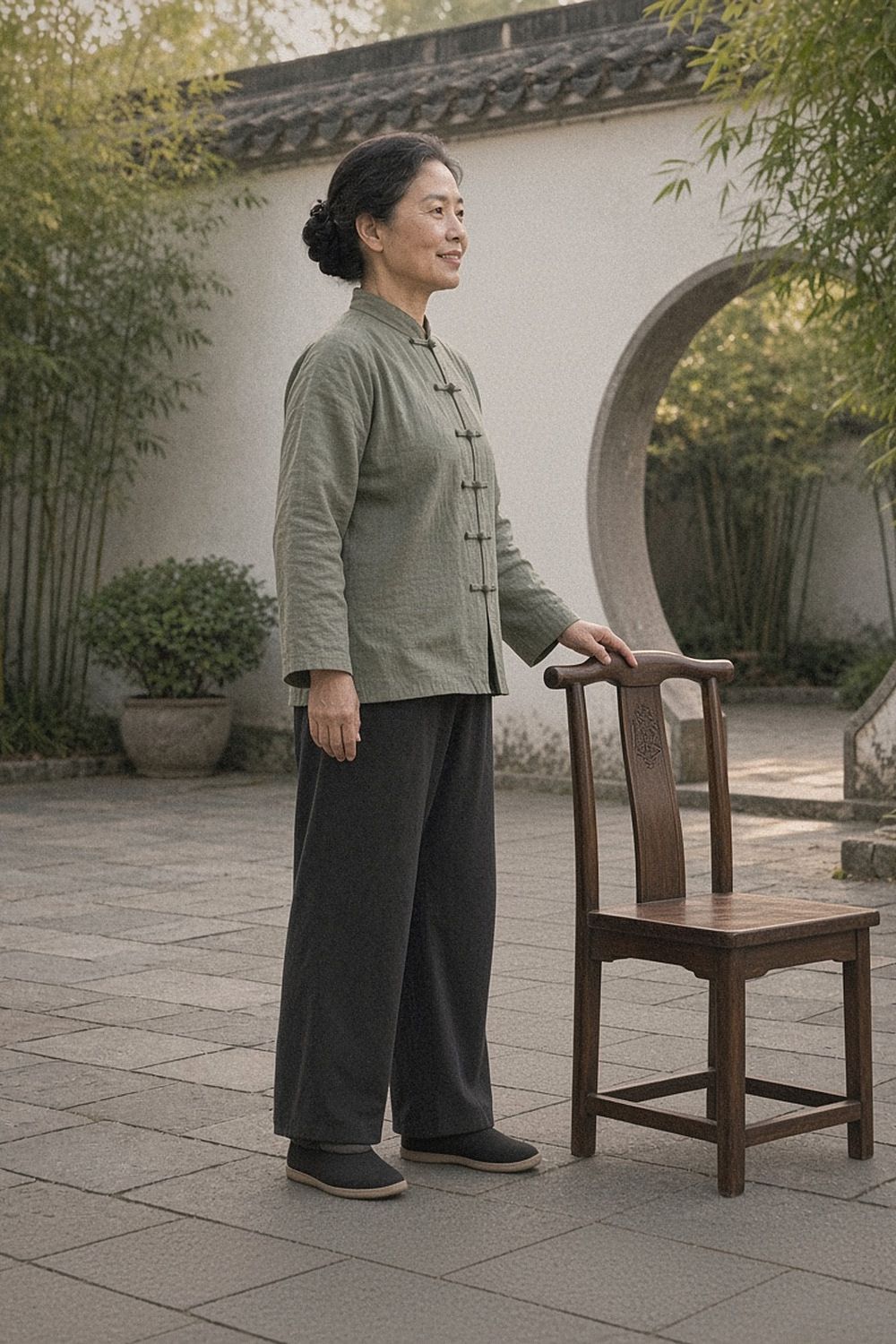
This is the starting position for every move that follows. It lets you feel steady before you move.
How to do it:
- Stand beside a sturdy chair and rest one hand lightly on the back, as in the photo.
- Feet hip width apart, knees soft, not locked.
- Let your shoulders drop, lengthen the back of your neck and breathe slowly for 5 breaths.
Make it easier: Do it sitting tall near the front of your chair.
How much: 5 slow breaths.
2. Hold the Ball
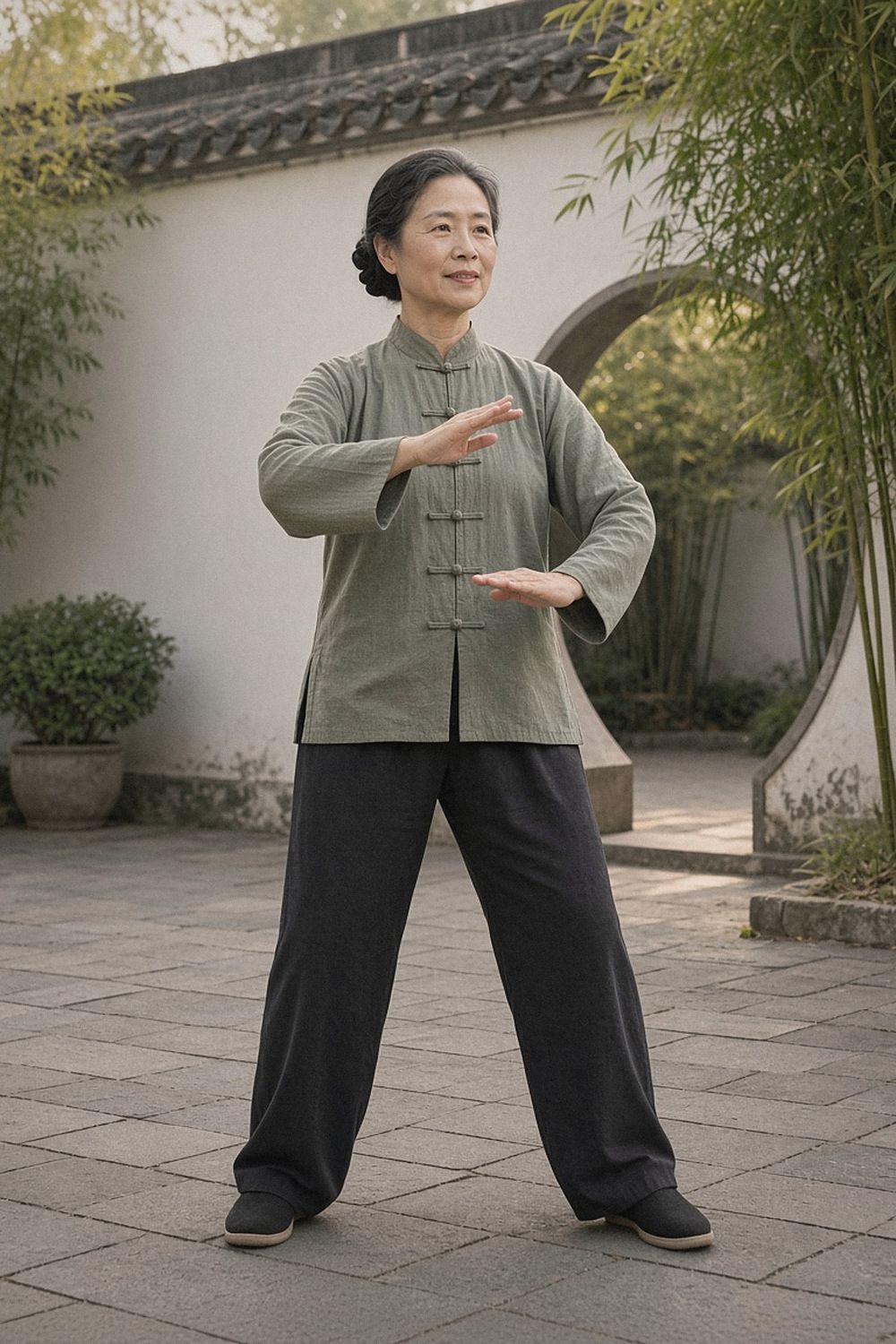
It is gentle on the shoulders and appears between many tai chi moves, so it is a great first shape to learn.
How to do it:
- Stand with your feet shoulder width apart and your knees soft.
- Bring one hand to chest height, palm down, and the other to belly height, palm up, as if holding a beach ball.
- Slowly swap hands so the ball turns over. Breathe in as you turn, out as you settle.
Make it easier: Do it seated, or keep one hand on your chair and turn an imaginary small ball with the other.
How much: 5 slow swaps.
3. Cloud Hands at a Chair
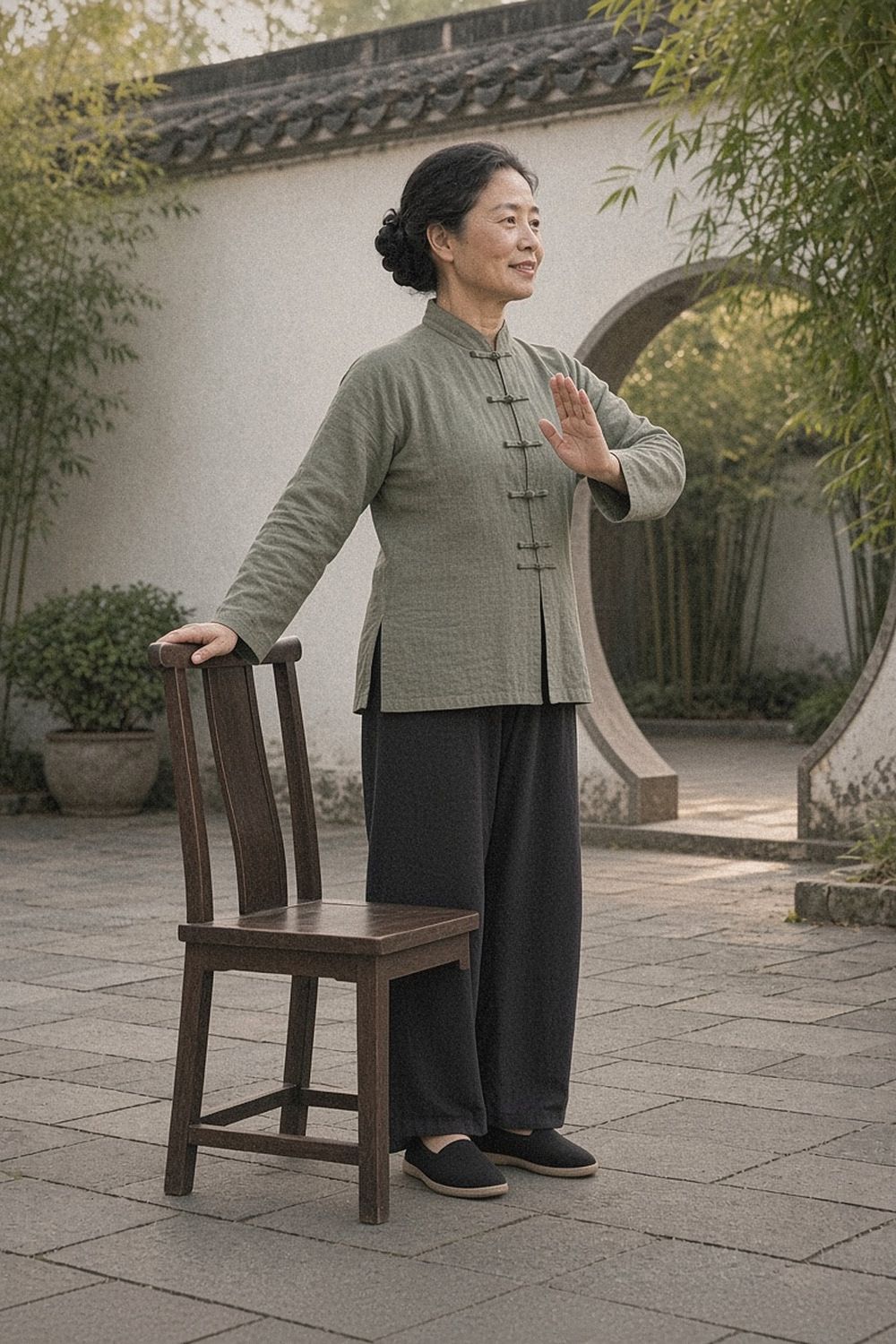
This is a supported version of Wave Hands Like Clouds. The chair lets you practise a gentle turn without worrying about balance.
How to do it:
- Stand beside your chair with one hand resting on the back, as in the photo.
- Bring your free hand up to chest height, palm facing you.
- Turn your waist slowly so the hand drifts across in front of you, then back again, like a cloud passing by.
Make it easier: Keep the turn very small, or do the arm movement seated.
How much: 5 slow turns each way, then switch hands.
4. Gentle Push
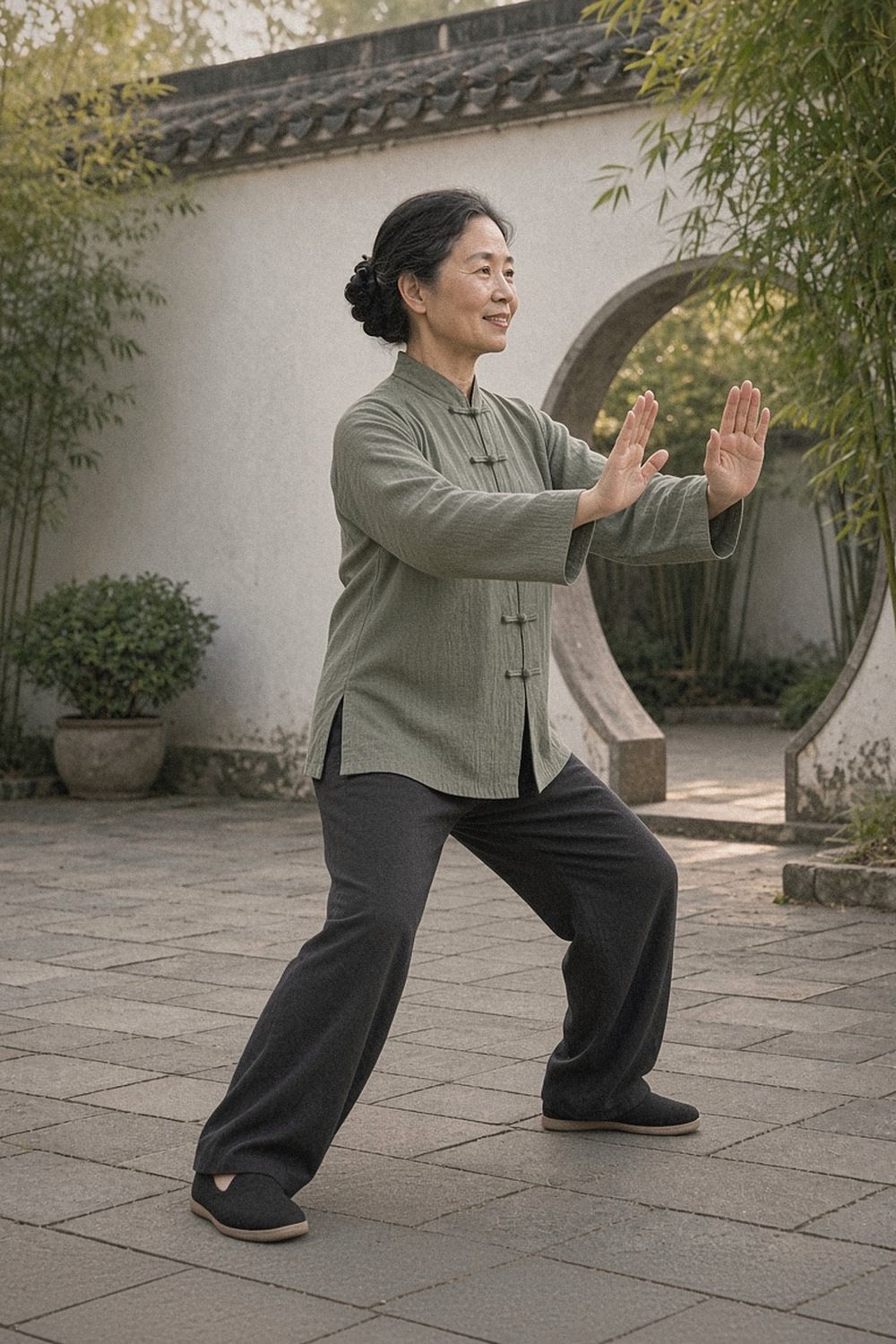
It trains a slow, controlled weight shift from one leg to the other, which you use every time you walk.
How to do it:
- Stand with one foot a short step in front of the other, near your chair.
- Bring both hands to chest height, palms facing forward and elbows soft.
- Slowly shift your weight onto your front foot as your hands move forward a little, then shift back.
Make it easier: Keep your feet side by side and just move your hands forward and back with your breath.
How much: 5 slow pushes, then switch feet.
5. White Crane Spreads Wings
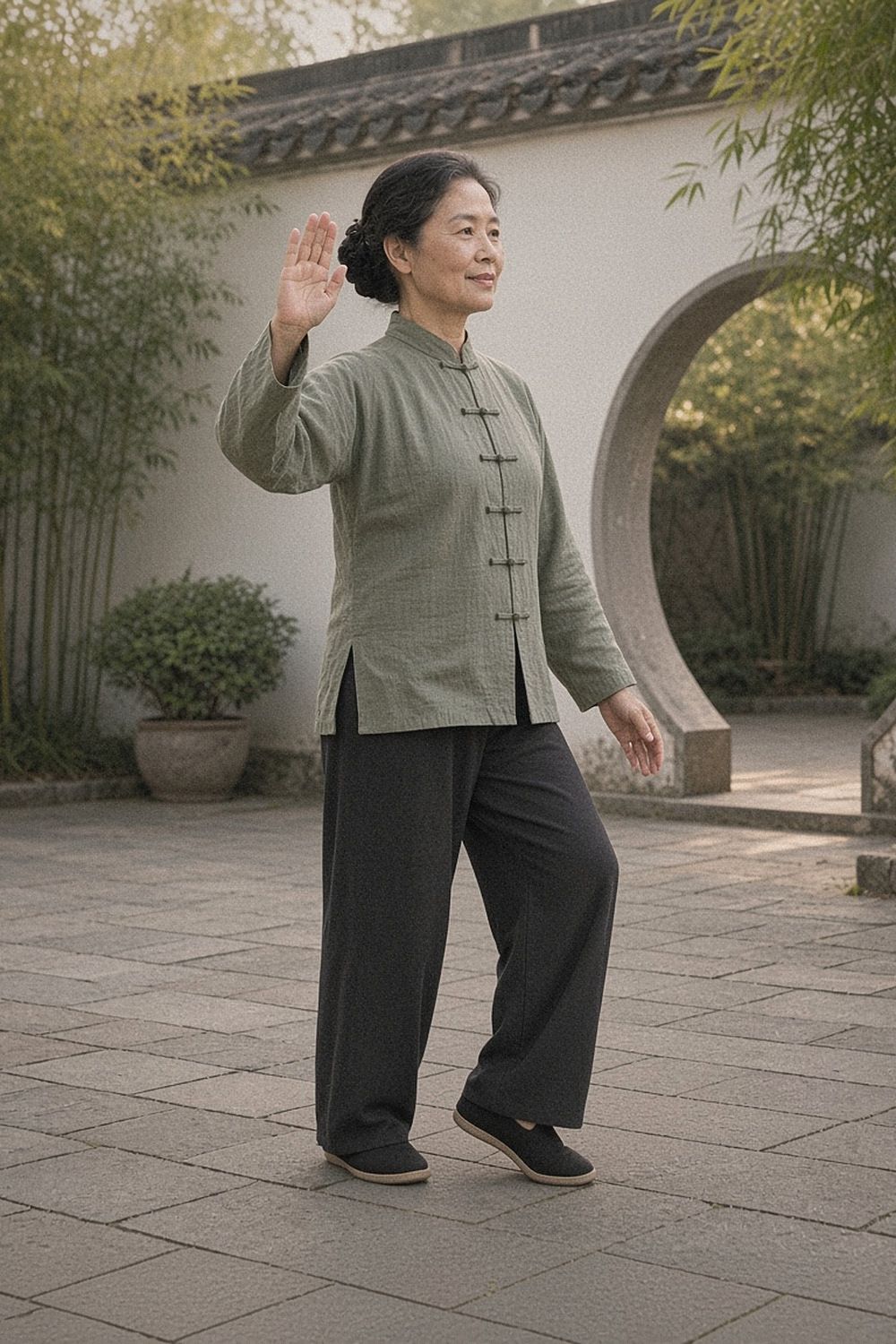
Your front foot stays touching the floor, so this is a safe first step toward balancing on one leg.
How to do it:
- Stand with your chair beside you. Shift most of your weight onto one leg.
- Rest the toes of your other foot lightly on the floor in front.
- Raise the hand on your standing side beside your temple, palm out, and rest the other hand by your hip, or on the chair.
Make it easier: Keep both feet flat and just raise and lower your arm.
How much: Hold for 3 breaths, 2 times each side.
How to find a tai chi class
A teacher can watch you and adjust things for you, which helps a lot at the start. Harvard Health suggests you “Ask about classes at your local Y, senior center, or community education center.”
- Ask at your local senior center, community center, library or YMCA.
- Ask your doctor, physical therapist or hospital if they run or know of fall prevention classes.
- In the US, some Medicare Advantage plans include fitness programs, such as SilverSneakers, that offer tai chi classes. Check what your plan covers.
- Try a class before you pay for a full course. Most teachers are happy for you to watch first.
One thing to know: NCCIH points out that “Tai chi instructors don’t have to be licensed.” So ask how long they have taught, whether they teach older beginners and whether they offer seated or supported options.
A gentle 10 minute session
Keep your chair close the whole time. Rest whenever you like.
| Step | What to do | Amount |
|---|---|---|
| 1 | Stand Tall With Support | 5 breaths |
| 2 | Shoulder circles and gentle head turns | 1 minute |
| 3 | Hold the Ball | 5 swaps |
| 4 | Cloud Hands at a Chair | 5 turns each way, each hand |
| 5 | Gentle Push | 5 pushes each side |
| 6 | White Crane Spreads Wings | 2 holds each side |
| 7 | Sit and breathe slowly | 1 minute |
Your 4 week plan
Go slowly. It is fine to stay on one week for longer.
| Week | What to do |
|---|---|
| Week 1 | Stand Tall With Support and Hold the Ball, 5 minutes a day, 3 days a week. |
| Week 2 | Add Cloud Hands at a Chair. Try the full 10 minute session twice. |
| Week 3 | Add Gentle Push and White Crane Spreads Wings. Do the session 3 days a week. |
| Week 4 | Do the session most days, or join a class and use this as home practice. |
When to check with your doctor
Harvard Health advises checking with your care team before starting tai chi if you have a condition that limits movement or take medicines that can make you dizzy. Talk to your doctor first if any of these apply to you:
- You have had a fall in the past year, or you often feel unsteady or dizzy.
- You have a hip or knee replacement, or joint pain that limits how you move.
- You have osteoporosis or a heart or lung condition.
- You take medicines that can make you dizzy or lightheaded.
- You have had recent surgery or a recent illness.
Frequently asked questions
Can a 70 or 80 year old do tai chi?
Yes. Tai chi is one of the most popular forms of exercise for people in their 70s, 80s and beyond. Start seated or holding a chair, keep moves small and build up slowly.
Is it better to take a class or learn at home?
A class is best at the start, because a teacher can correct small things. Home practice between classes helps you remember the moves. If there is no class near you, a slow video made for beginners is a good second choice.
How often should seniors do tai chi?
Two or three times a week is a good start. Harvard Health notes that most beginner programs in research “last at least 12 weeks, with instruction once or twice a week and practice at home.”
What is the best tai chi style for seniors?
Most classes for older adults teach a short Yang style form, with small, slow moves. Harvard Health says a short form “with smaller, slower movements is usually recommended at the beginning, especially if you’re older.”
Is tai chi or walking better for seniors?
They work well together. Walking is great for your heart and legs, while tai chi adds slow balance and posture practice. Many people walk on some days and do tai chi on others.
Want a one page version? Get our free mini tai chi chart with 5 easy moves and clear photos. Download the free chart.
Keep going
Ready for more? Our tai chi for beginners guide teaches 10 moves step by step. If you prefer to sit, try chair tai chi. To focus on steadiness, see tai chi for balance, and for the names and shapes of more moves, see our tai chi moves guide. Back to our guide to gentle exercise.

Written by June Ashby
June writes the Limber Years guides to posture, tai chi, mobility and gentle strength for people over 50. She keeps every routine short, gentle and easy to follow at home. June is not a doctor or physical therapist, so please check with yours before starting something new. More about Limber Years
Sources
This article is general information, not medical advice. Read our full disclaimer.