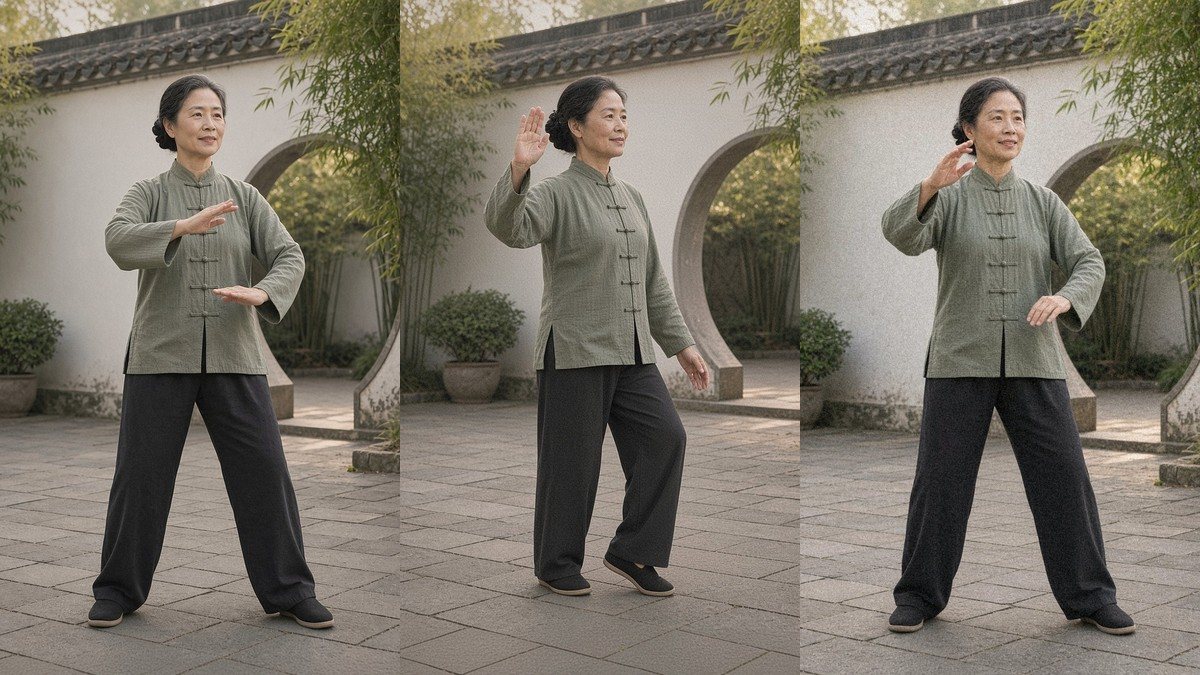
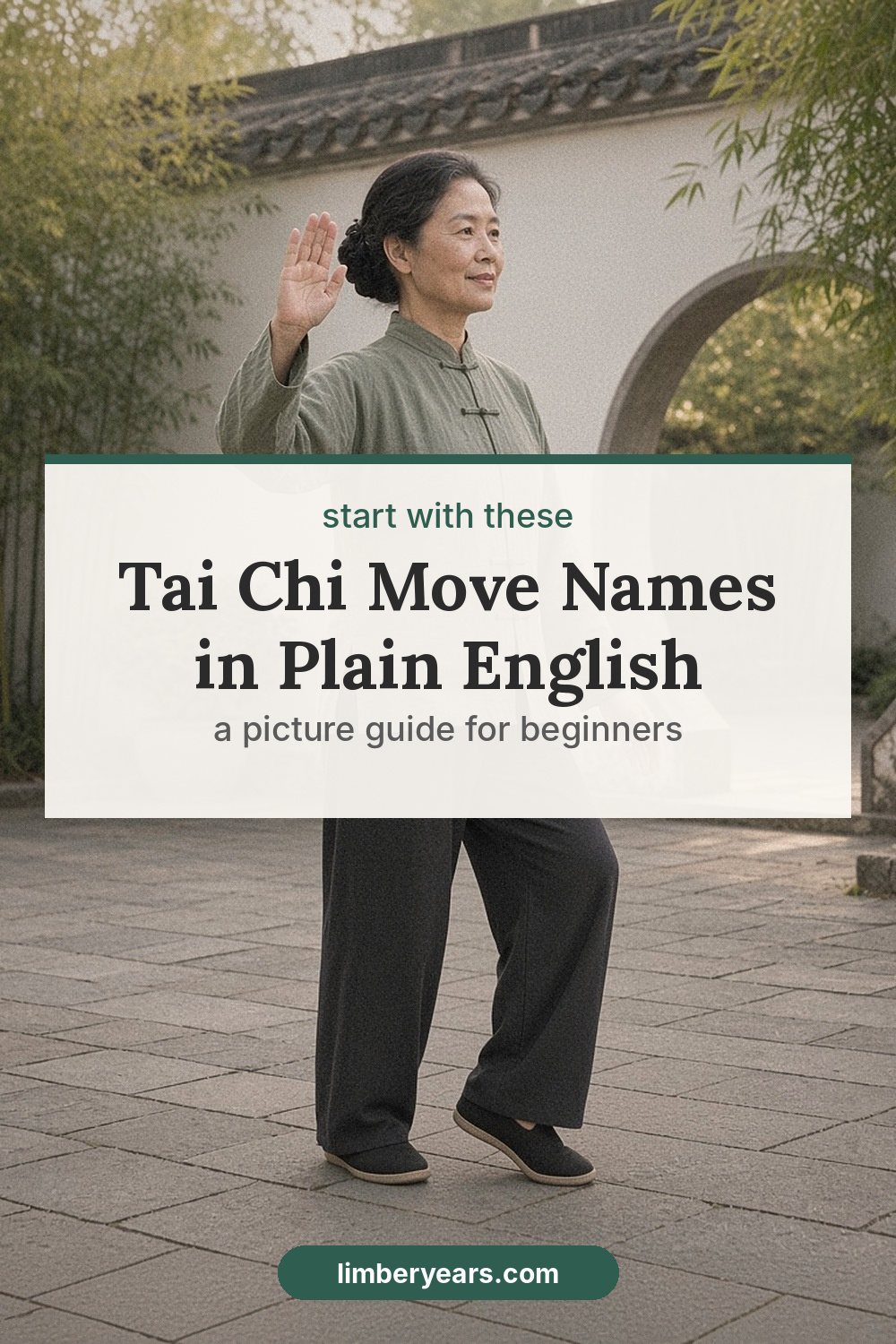
Tai chi moves have lovely names. Wave Hands Like Clouds. White Crane Spreads Wings. Repulse the Monkey. But if you are new, the names can make the whole thing feel like a foreign language.
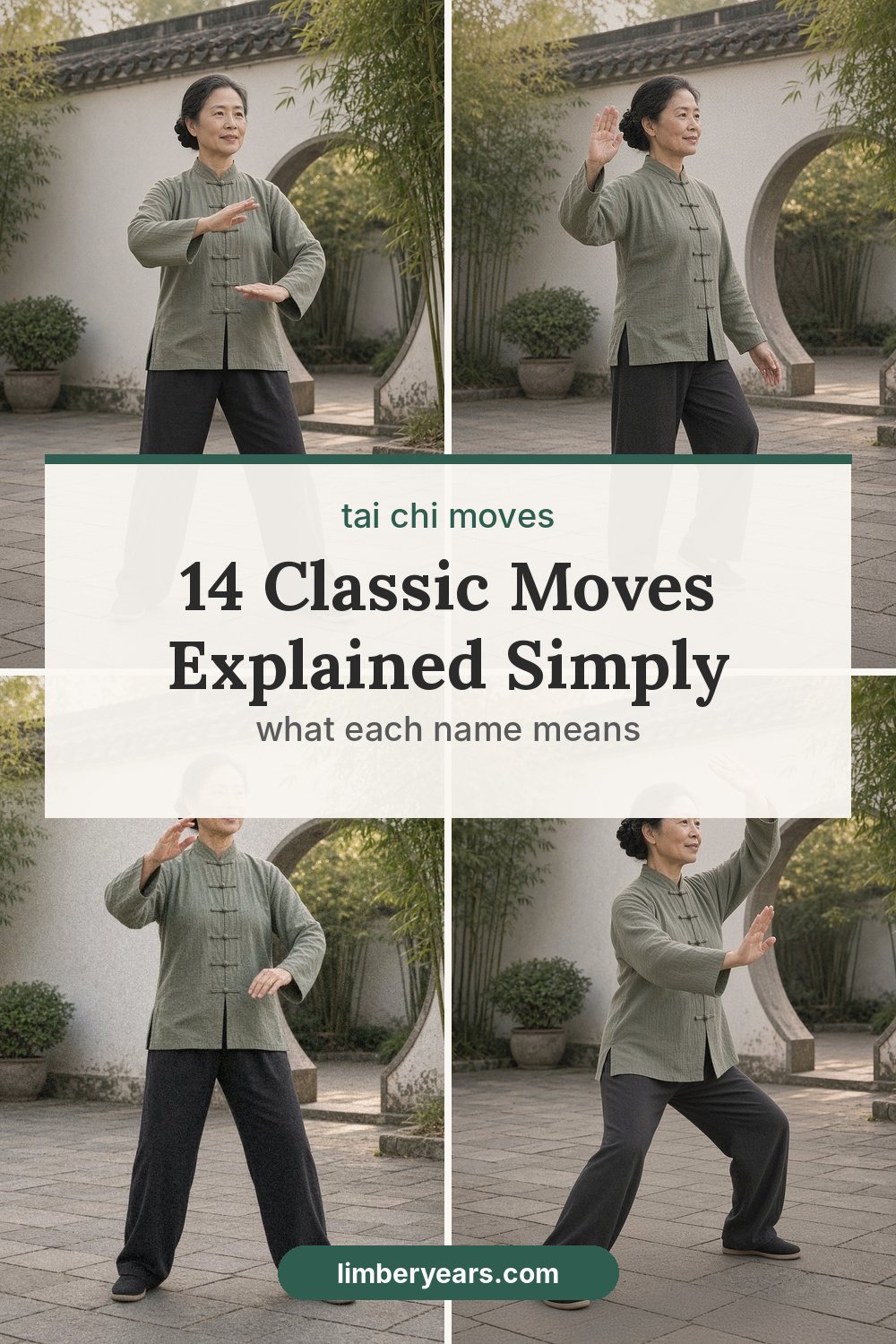
This page is a picture guide to 14 classic tai chi moves. For each one you get a photo, what the name means in plain English, a few simple steps and an easier way to do it.
Use it as a reference next to a class or video, or as a way to learn one or two new moves at a time at home.
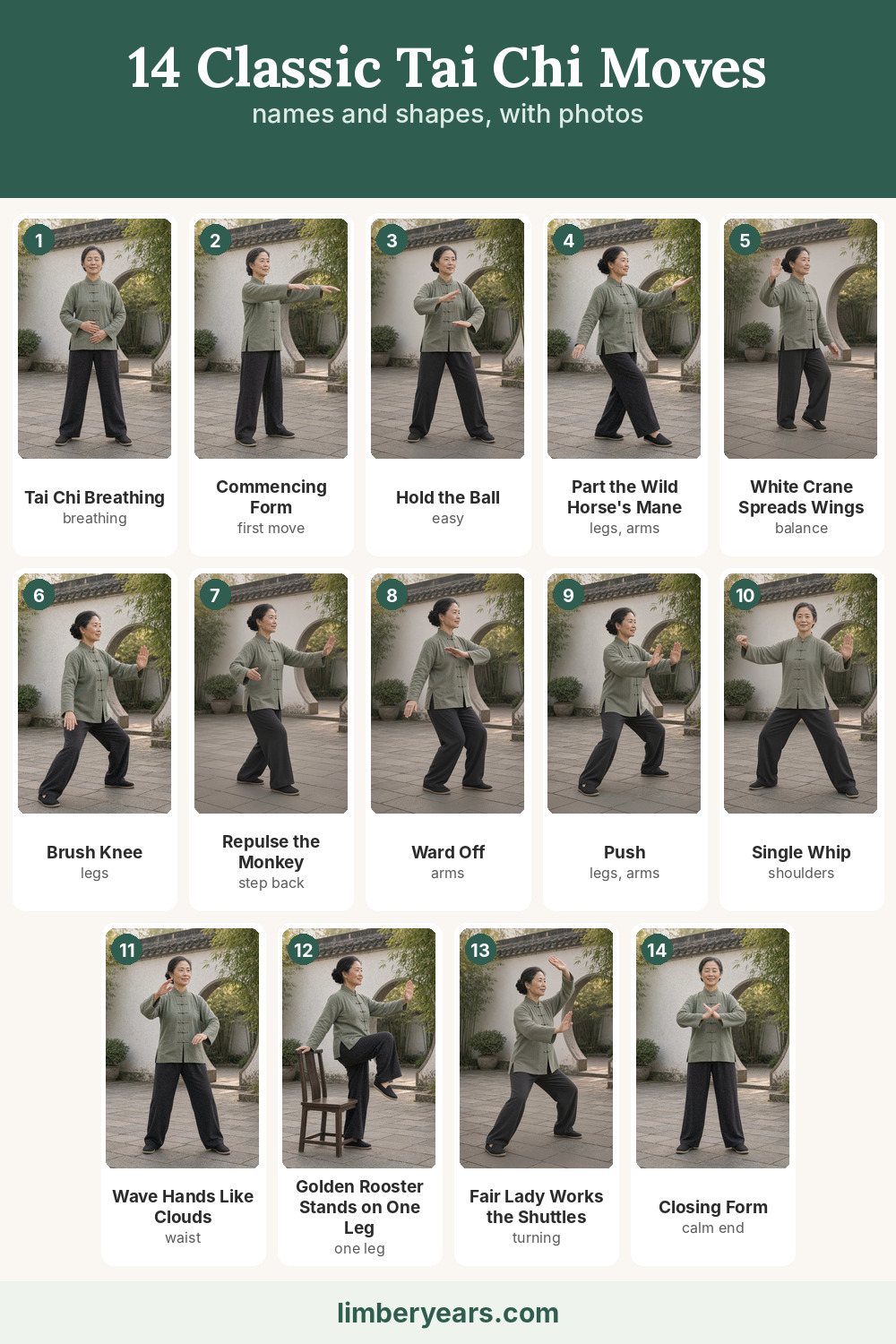
Save this chart to Pinterest or print it out as a reminder of the names and shapes. Photos on this site are made with AI to show each move clearly.
Key takeaways
- Tai chi moves are slow, soft and circular. Nothing is forced or locked.
- A form is a set of moves done in order. Short forms are best for beginners.
- The names describe a picture, like holding a ball or parting a horse’s mane, to help you remember the shape.
- Every move can be made easier with shorter steps, smaller arms or a chair to hold.
Before you start
- Wear loose clothes and flat, flexible shoes, or go barefoot on a non slip floor.
- Clear a small space and keep a sturdy chair nearby to hold if you need it.
- Keep your knees soft, never locked, and your steps short.
- Breathe slowly through your nose and never hold your breath.
- Stop if you feel pain, dizziness or shortness of breath.
What makes a move tai chi?
The National Center for Complementary and Integrative Health (NCCIH) describes tai chi like this:
Tai chi is a practice that involves a series of slow gentle movements and physical postures, a meditative state of mind, and controlled breathing.
NCCIH: Tai chi, what you need to know
Harvard Health adds that the movements “are usually circular and never forced, the muscles are relaxed rather than tensed, the joints are not fully extended or bent.” So whatever move you are doing, the same rules apply: go slowly, stay soft and keep breathing.
Moves, forms and styles
A single move is a shape, like Hold the Ball. A form is a set of moves done one after another without stopping. Harvard Health explains that short forms “may include a dozen or fewer movements; long forms may include hundreds,” and that a short form “with smaller, slower movements is usually recommended at the beginning.”
You will also hear style names. Harvard Health notes that “Names like Yang, Wu, and Cheng are given to various branches of tai chi.” Most classes for beginners in the US and UK teach Yang style, and the moves on this page are Yang style moves.
The 14 tai chi moves at a glance
| # | Move | Works on | How much |
|---|---|---|---|
| 1 | Tai Chi Breathing | Calm and focus, easiest | 5 slow breaths |
| 2 | Commencing Form | Shoulders and legs, easy | 3 to 5 slow times |
| 3 | Hold the Ball | Arms and posture, easy | 5 slow swaps |
| 4 | Part the Wild Horse’s Mane | Legs, waist and arms, medium | 3 to 5 times each side |
| 5 | White Crane Spreads Wings | Balance and posture, medium | Hold for 3 breaths, then switch sides |
| 6 | Brush Knee | Legs and coordination, medium | 3 to 5 times each side |
| 7 | Repulse the Monkey | Balance and coordination, medium | 4 slow steps back |
| 8 | Ward Off | Arms and legs, medium | 3 to 5 times each side |
| 9 | Push | Legs and arms, medium | 5 slow pushes |
| 10 | Single Whip | Shoulders and legs, harder | Hold for 3 breaths, then switch sides |
| 11 | Wave Hands Like Clouds | Waist and balance, easy | 5 slow circles each way |
| 12 | Golden Rooster Stands on One Leg | Balance, harder | Hold for 3 to 5 seconds, 3 times each side |
| 13 | Fair Lady Works the Shuttles | Shoulders, legs and turning, harder | 2 to 4 times each side |
| 14 | Closing Form | Calm, easiest | 3 slow breaths |
1. Tai Chi Breathing
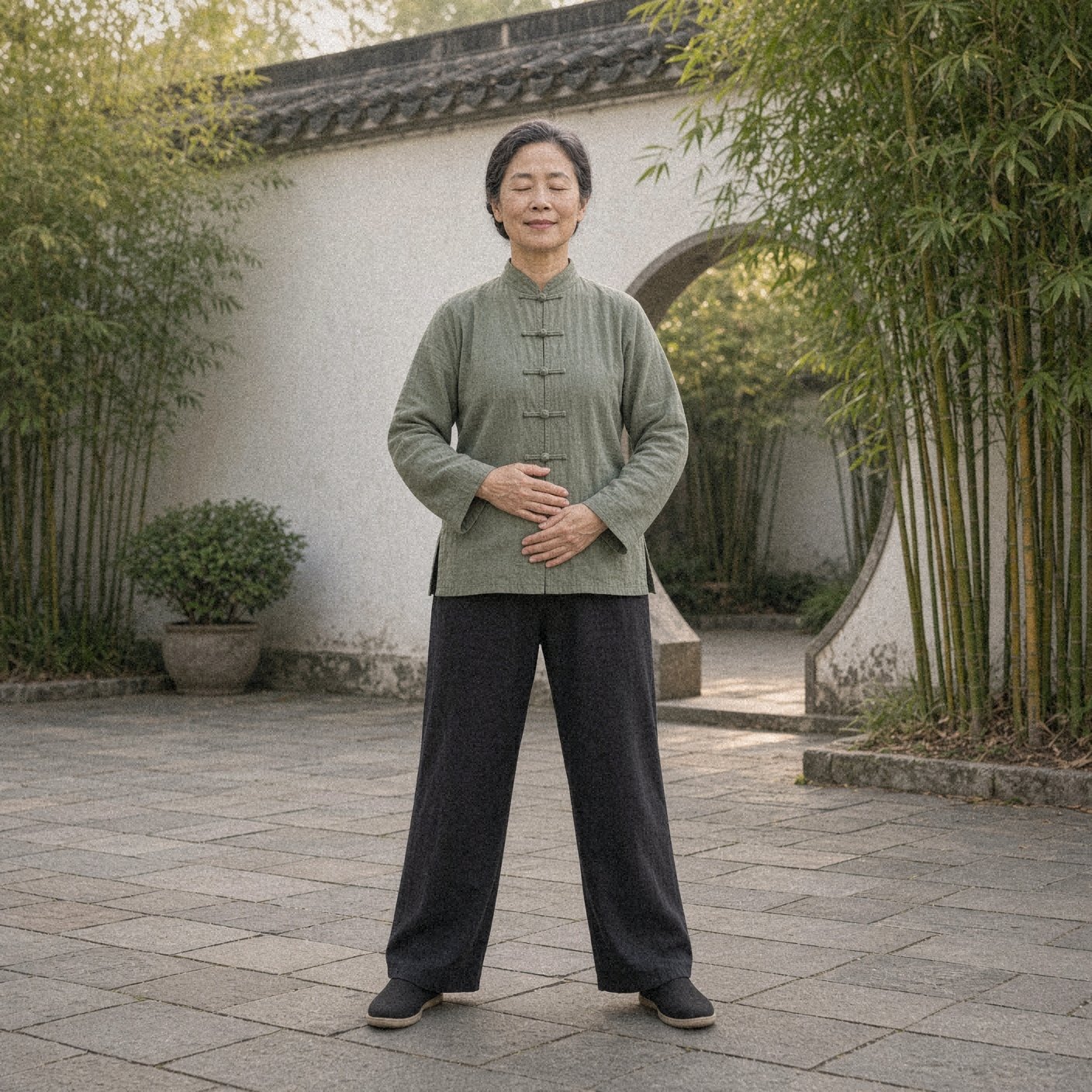
Slow breathing is part of every tai chi move, so it is worth practising on its own first.
What the name means: Not a named form move, but most classes start with it. It settles your mind and sets the slow pace for everything else.
How to do it:
- Stand with your feet hip width apart and your knees soft.
- Rest your hands on your belly, as in the photo.
- Breathe in slowly through your nose and feel your belly rise, then breathe out slowly.
Make it easier: Do it sitting in a chair.
How much: 5 slow breaths.
2. Commencing Form
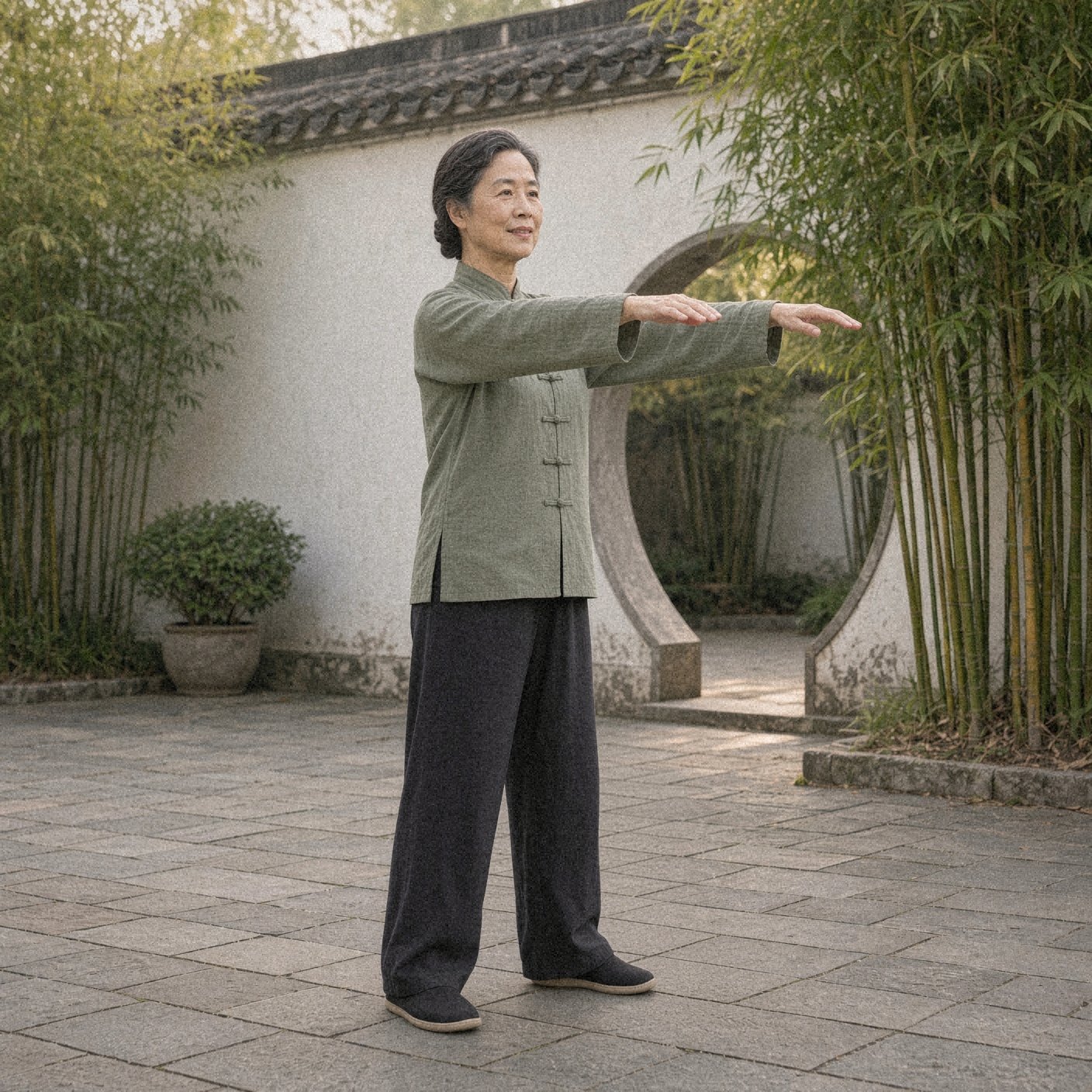
It teaches you to move your arms with your breath and to sink gently through your legs.
What the name means: “Commencing” just means beginning. It is the first move of most forms.
How to do it:
- Stand with your feet shoulder width apart and your arms by your sides.
- Breathe in and let your arms float up in front of you to shoulder height, palms down, as in the photo.
- Breathe out, soften your knees a little and let your hands sink slowly back down.
Make it easier: Raise your arms only to chest height and keep your knees almost straight.
How much: 3 to 5 slow times.
3. Hold the Ball
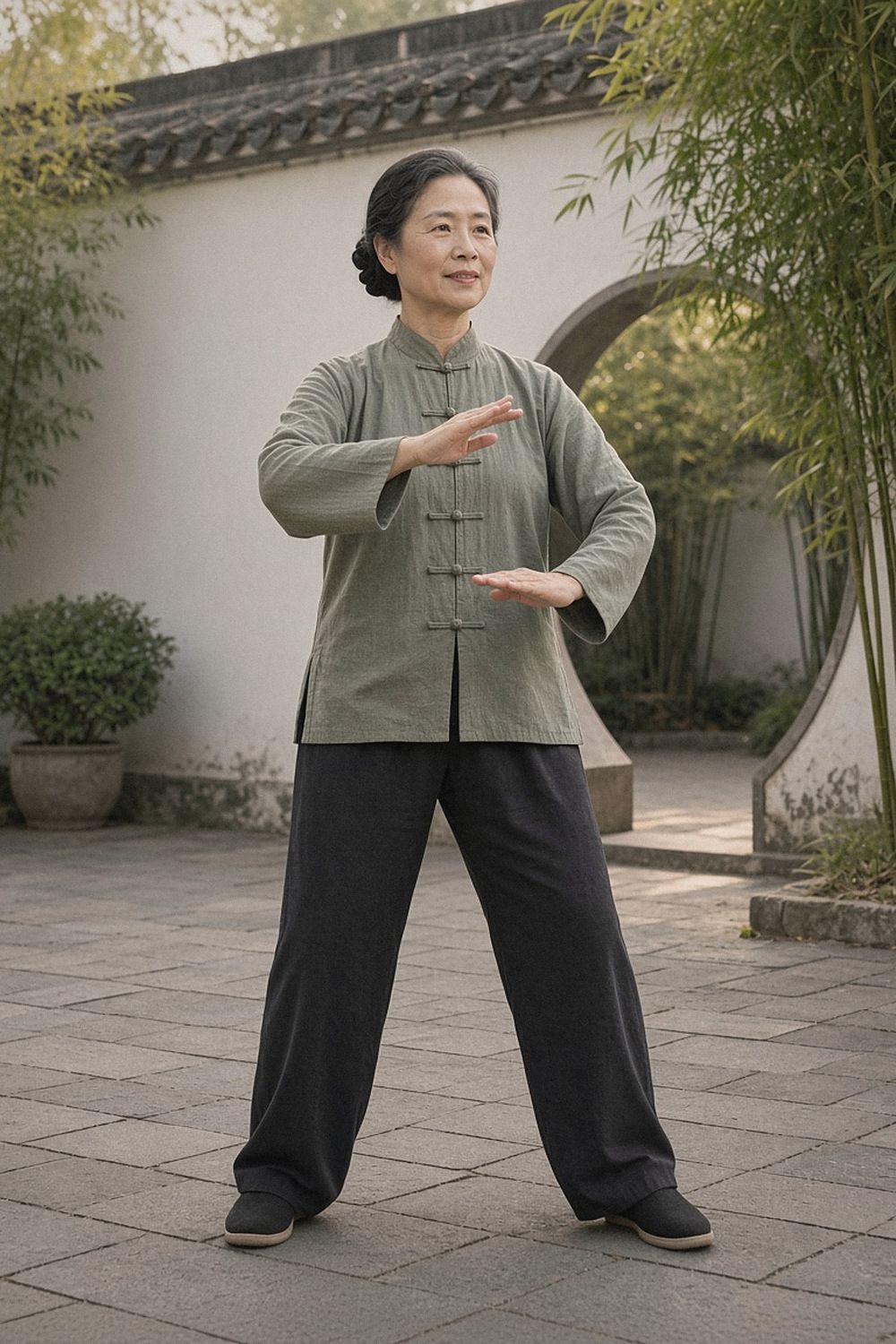
This shape appears between many other moves, so knowing it makes a form much easier to follow.
What the name means: Your hands make the shape of holding a large beach ball in front of your body.
How to do it:
- Stand with your feet shoulder width apart and your knees soft.
- Bring one hand to chest height, palm down, and the other to belly height, palm up, as in the photo.
- Keep your shoulders relaxed, then swap hands slowly so the ball turns over.
Make it easier: Hold a smaller ball, with your hands closer together.
How much: 5 slow swaps.
4. Part the Wild Horse’s Mane
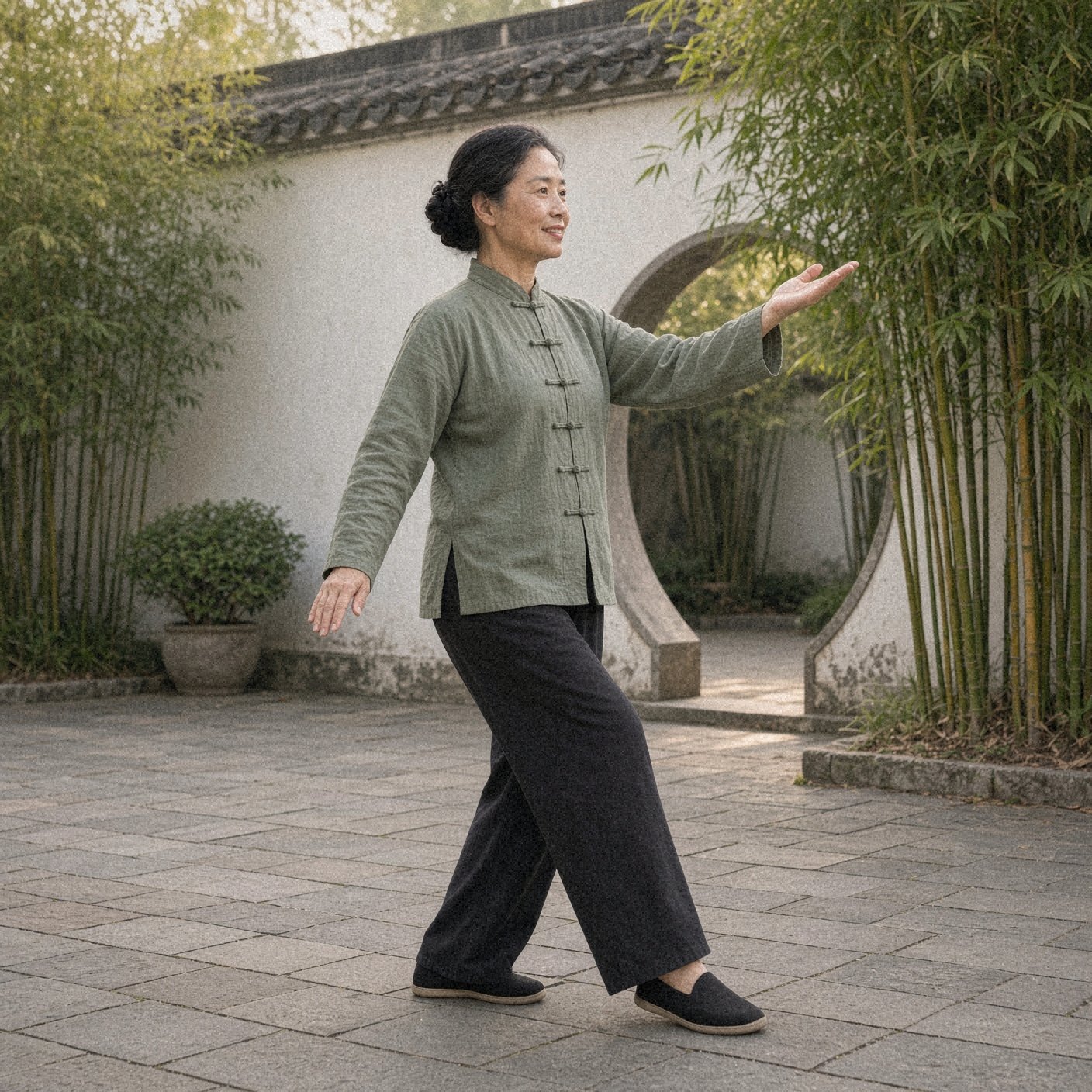
It is one of the first moves in many short forms and trains a smooth shift of weight from one leg to the other.
What the name means: Your arms sweep apart like hands parting the long hair on a horse’s neck.
How to do it:
- Start in Hold the Ball.
- Step one foot forward at a slight angle and shift your weight onto it.
- As you shift, let your front hand rise to shoulder height and your back hand press down by your hip, as in the photo.
Make it easier: Keep your feet still and just shift your weight while your arms move.
How much: 3 to 5 times each side.
For a full step by step guide, see this move in our tai chi for beginners guide.
5. White Crane Spreads Wings
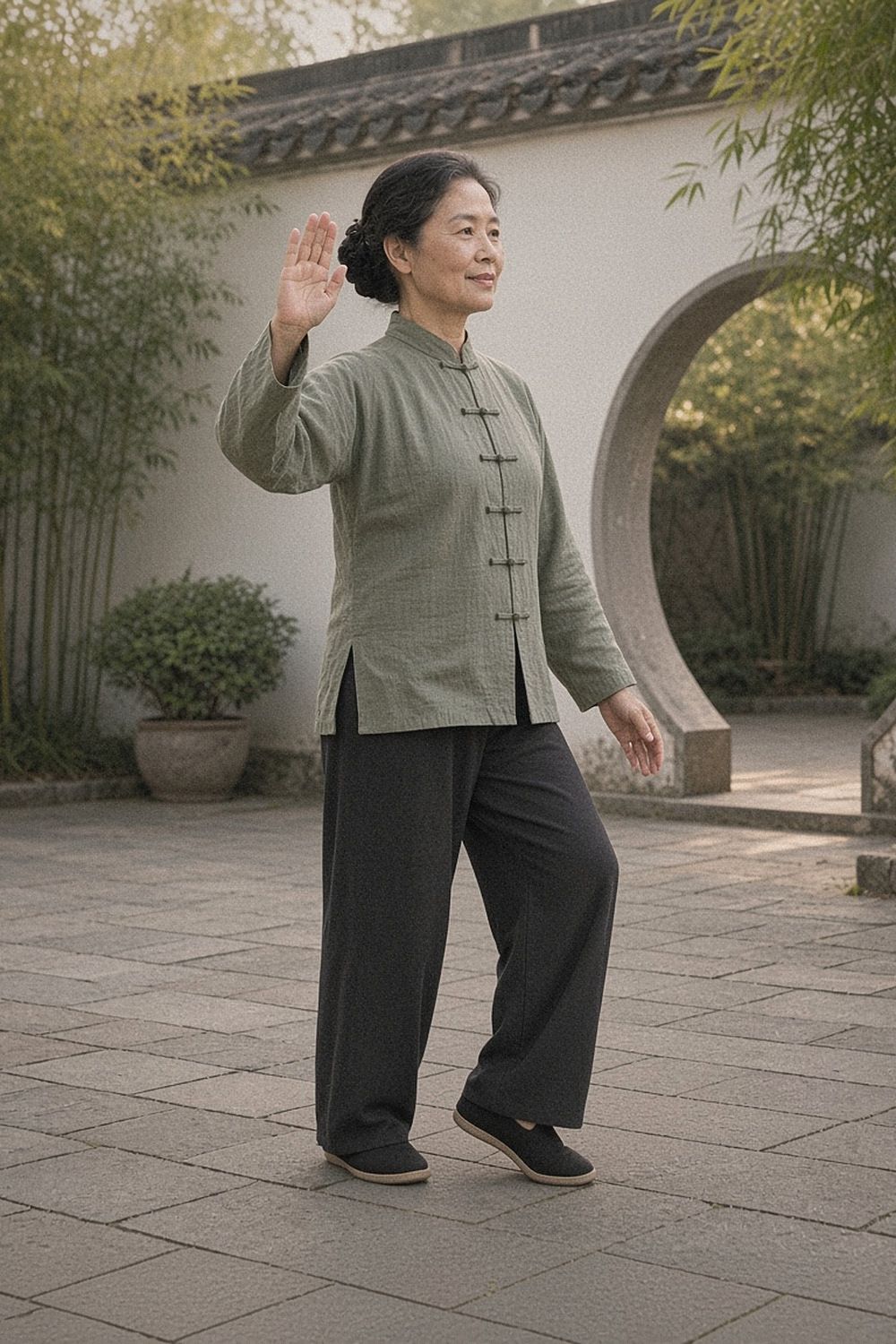
Most of your weight sits on one leg, which gives you gentle balance practice with the other foot still touching down.
What the name means: One hand rises and the other lowers, like a crane opening its wings.
How to do it:
- Sit your weight back onto one leg.
- Rest the toes of your other foot lightly on the floor in front of you.
- Raise the hand on your standing side beside your temple, palm out, and rest the other hand down by your hip, as in the photo.
Make it easier: Keep both feet flat on the floor and just move your arms.
How much: Hold for 3 breaths, then switch sides.
6. Brush Knee
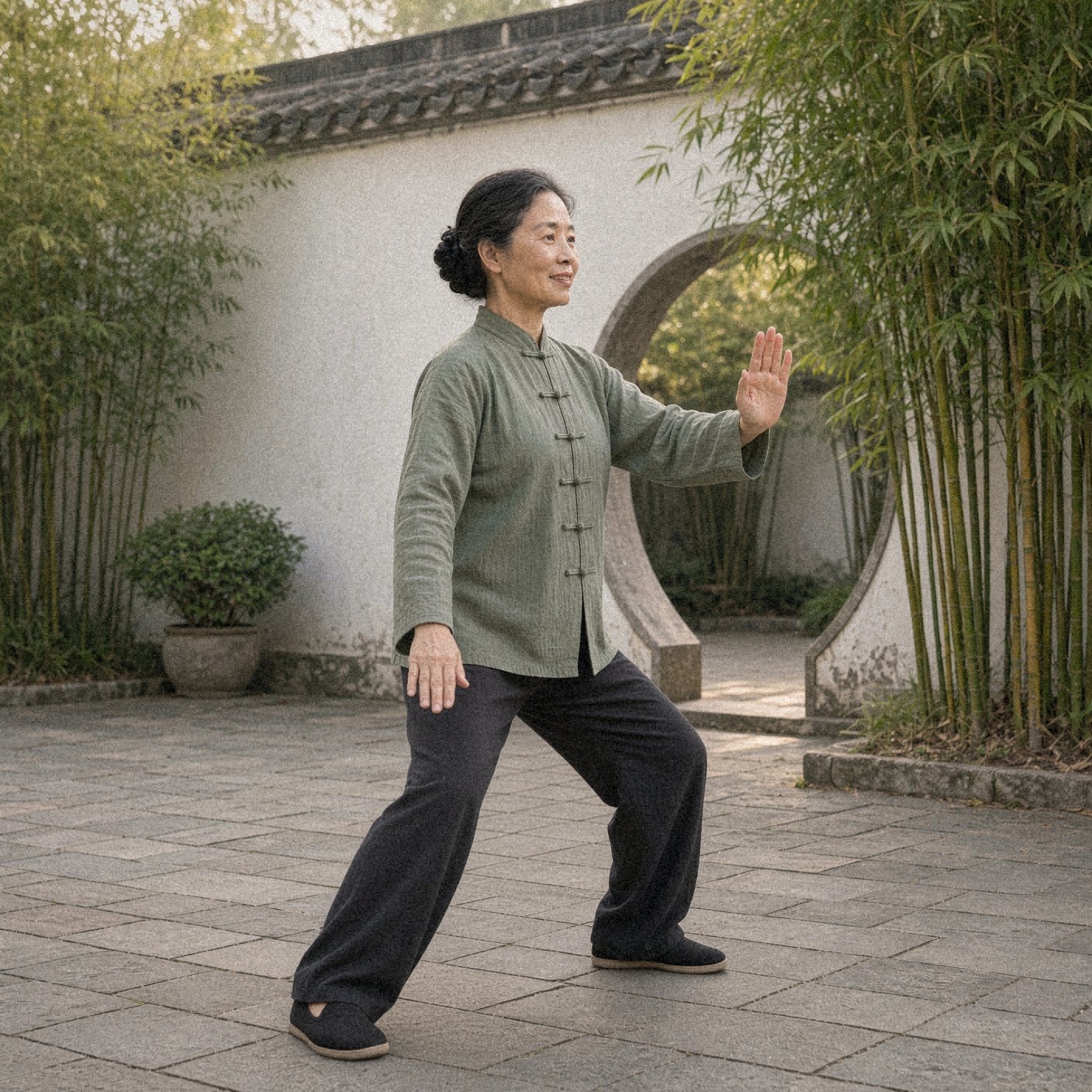
It links a step, a weight shift and two different arm movements, which is good practice for coordination.
What the name means: The full name is Brush Knee and Push. One hand brushes past your knee while the other pushes forward.
How to do it:
- Step one foot forward and shift your weight onto it.
- Let the hand on the same side as your front leg sweep down past your knee to your hip.
- At the same time, push the other hand slowly forward from beside your ear, as in the photo.
Make it easier: Take a very short step and keep your arm movements small.
How much: 3 to 5 times each side.
It is taught step by step in our tai chi for beginners guide.
7. Repulse the Monkey
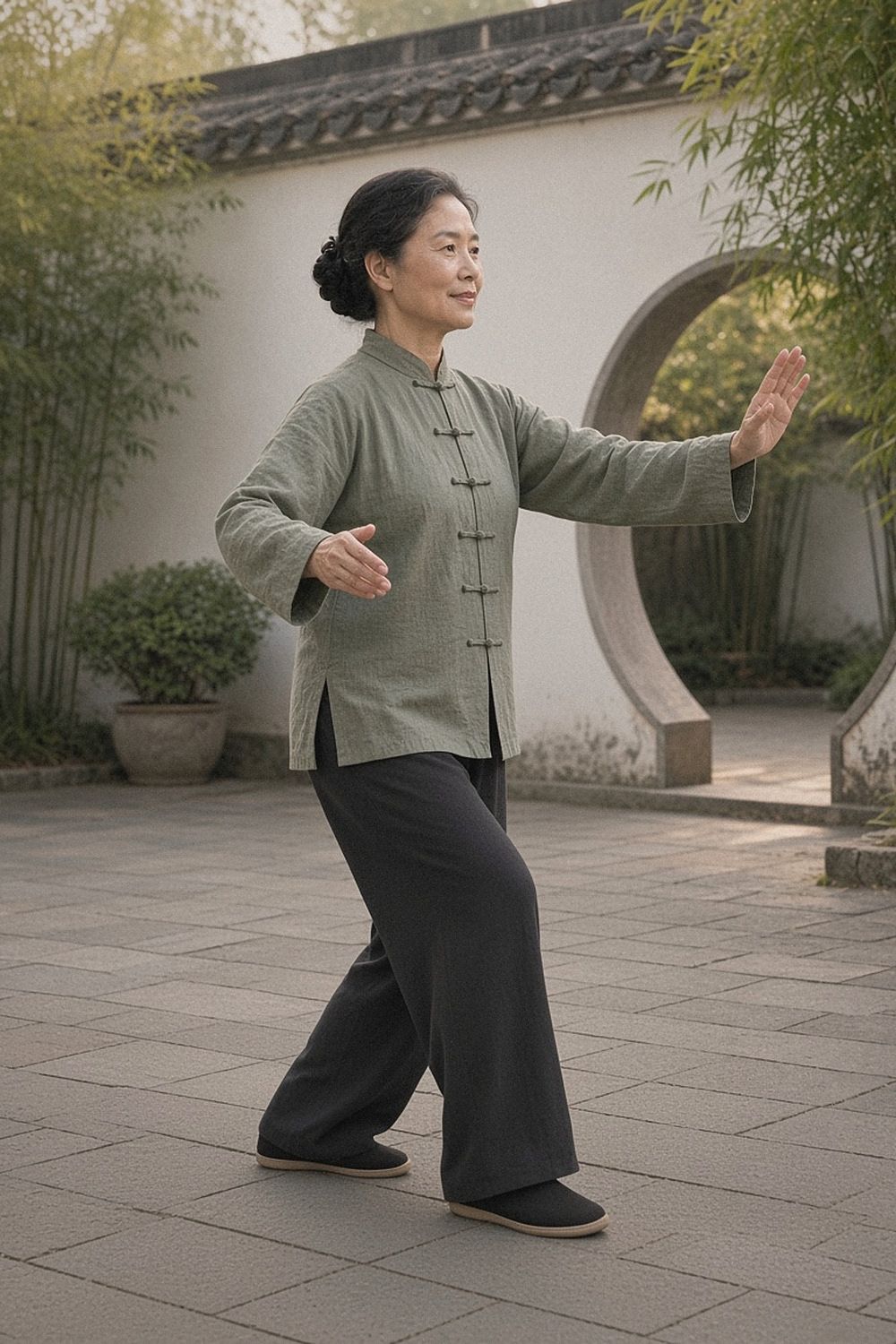
Walking backwards slowly is unusual for most of us, which makes it useful balance practice. Keep a chair or wall behind you.
What the name means: You step backwards while pushing a hand forward, as if gently keeping a cheeky monkey away.
How to do it:
- Step one foot back and slowly shift your weight onto it.
- As you step back, push one palm forward at shoulder height.
- Draw the other hand back to your hip, palm up, as in the photo. Then step back with the other foot and switch arms.
Make it easier: Do it with your feet still, just shifting your weight back and switching arms.
How much: 4 slow steps back.
8. Ward Off
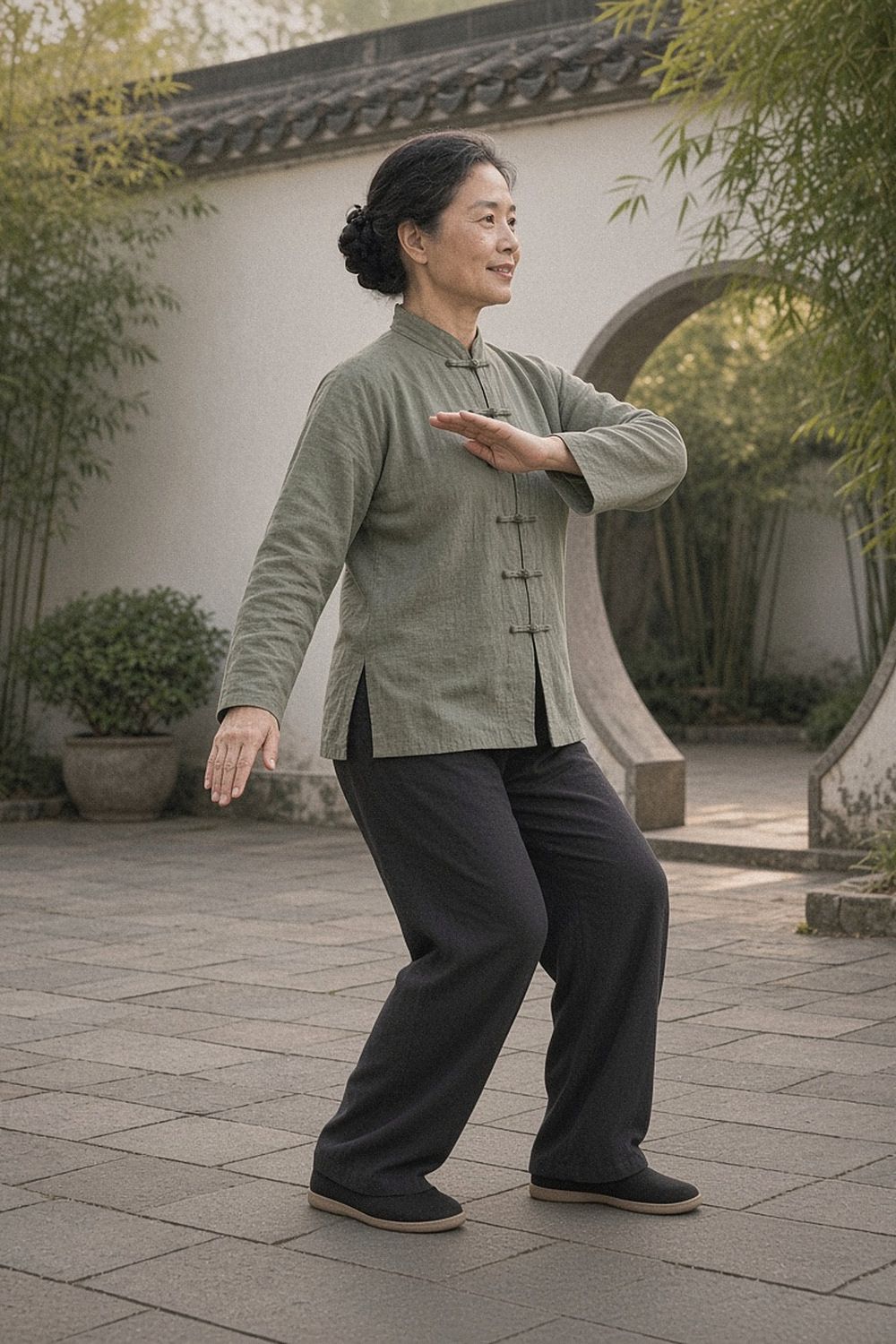
It trains you to hold a rounded, relaxed arm while your legs do the work.
What the name means: Your rounded forearm makes a soft shield in front of your chest. It is the first part of a longer move called Grasp the Bird’s Tail.
How to do it:
- Step one foot forward and shift most of your weight onto it.
- Raise your front forearm across your chest, rounded as if hugging a tree, palm facing you.
- Press your other hand gently down by your hip, as in the photo.
Make it easier: Keep your feet side by side and just make the arm shape.
How much: 3 to 5 times each side.
9. Push
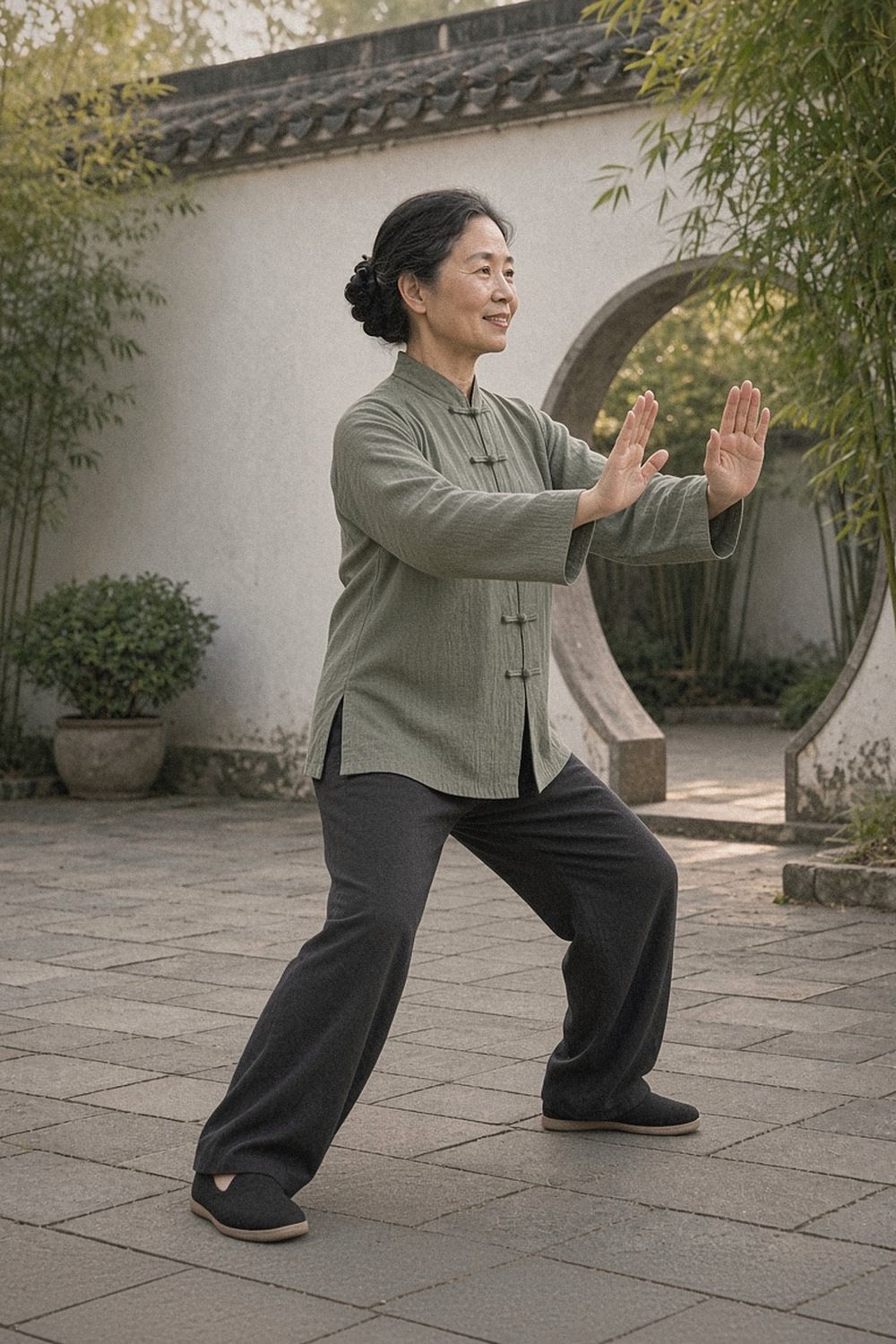
The push comes from your legs, not your arms, which teaches your body to move as one piece.
What the name means: A slow, gentle push with both palms. It is the last part of Grasp the Bird’s Tail.
How to do it:
- Stand with one foot in front of the other and your weight on the back leg.
- Bring both hands to chest height, palms facing forward and elbows soft.
- Shift your weight forward slowly and let your hands move forward with it, as in the photo. Do not lock your elbows.
Make it easier: Stand closer to a wall and push into the air in front of it, or keep the movement short.
How much: 5 slow pushes.
10. Single Whip
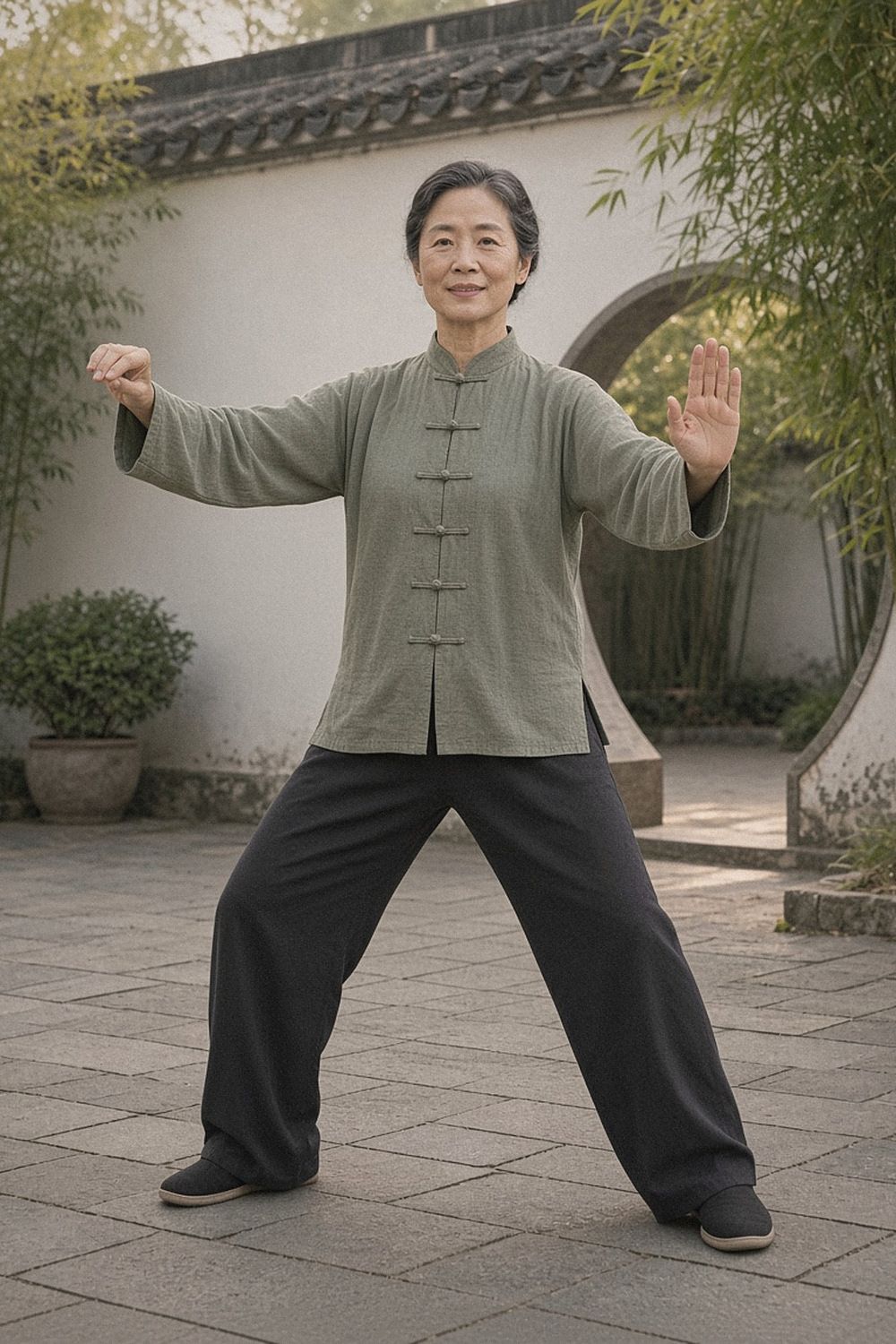
This is a bigger, more open shape. It works the shoulders and asks the legs to hold a wider stance.
What the name means: One arm reaches out to the side with the fingertips gathered together, like the handle of a whip.
How to do it:
- Stand in a wide, comfortable stance with your knees soft.
- Reach one arm out to the side and gently bring your fingertips and thumb together, pointing down.
- Turn your waist and push the other palm slowly forward at shoulder height, as in the photo.
Make it easier: Use a narrower stance and keep both hands open.
How much: Hold for 3 breaths, then switch sides.
11. Wave Hands Like Clouds
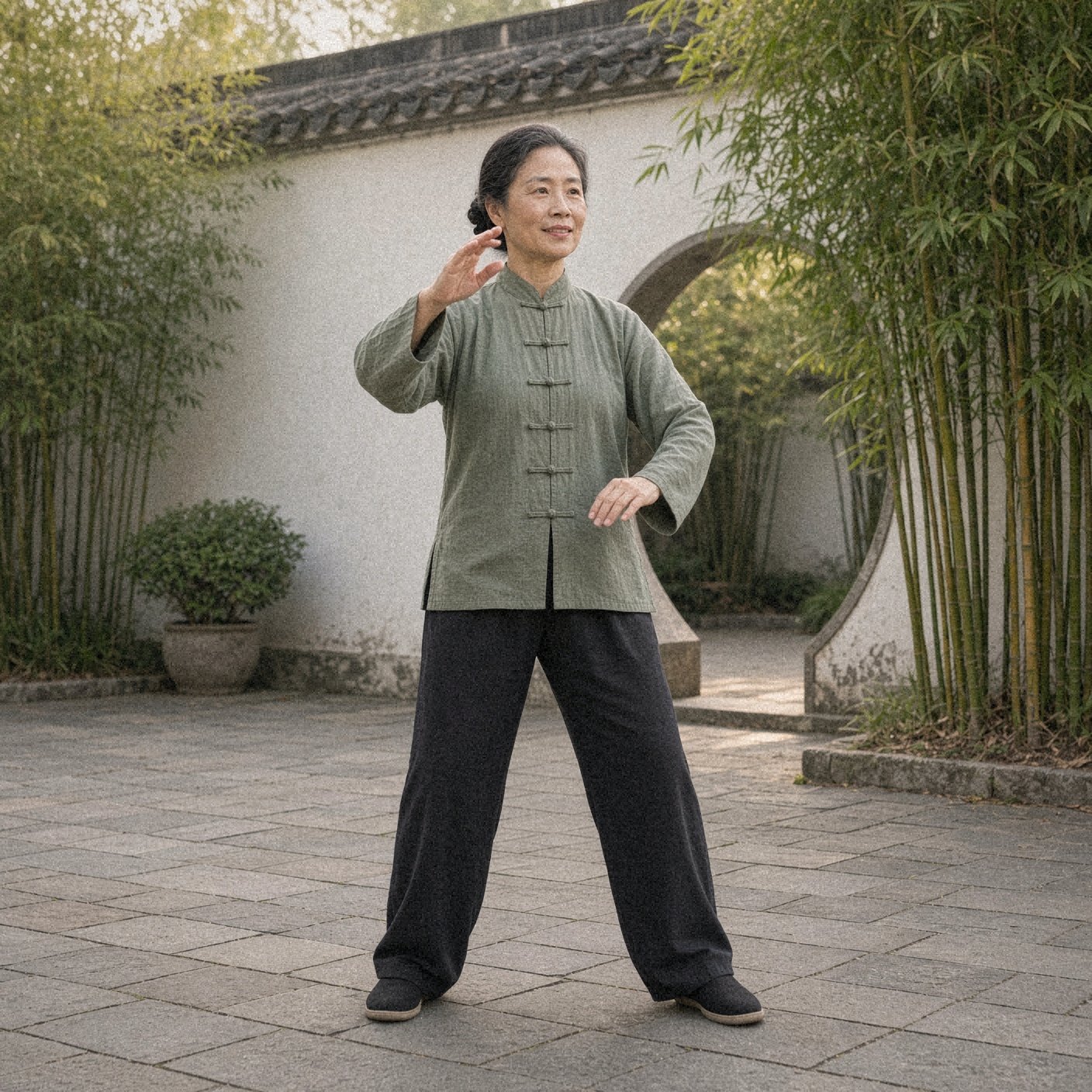
It is one of the best loved moves in tai chi, with a gentle turn of the waist and a smooth weight shift.
What the name means: Your hands drift past your face and belly like clouds moving across the sky.
How to do it:
- Stand with your feet a little wider than hip width.
- Let one hand pass slowly in front of your face and the other in front of your belly.
- Turn your waist gently as your hands circle and swap places, as in the photo.
Make it easier: Hold a chair with one hand and circle the other, or do it seated.
How much: 5 slow circles each way.
See the full steps in tai chi for beginners or a seated version in chair tai chi.
12. Golden Rooster Stands on One Leg
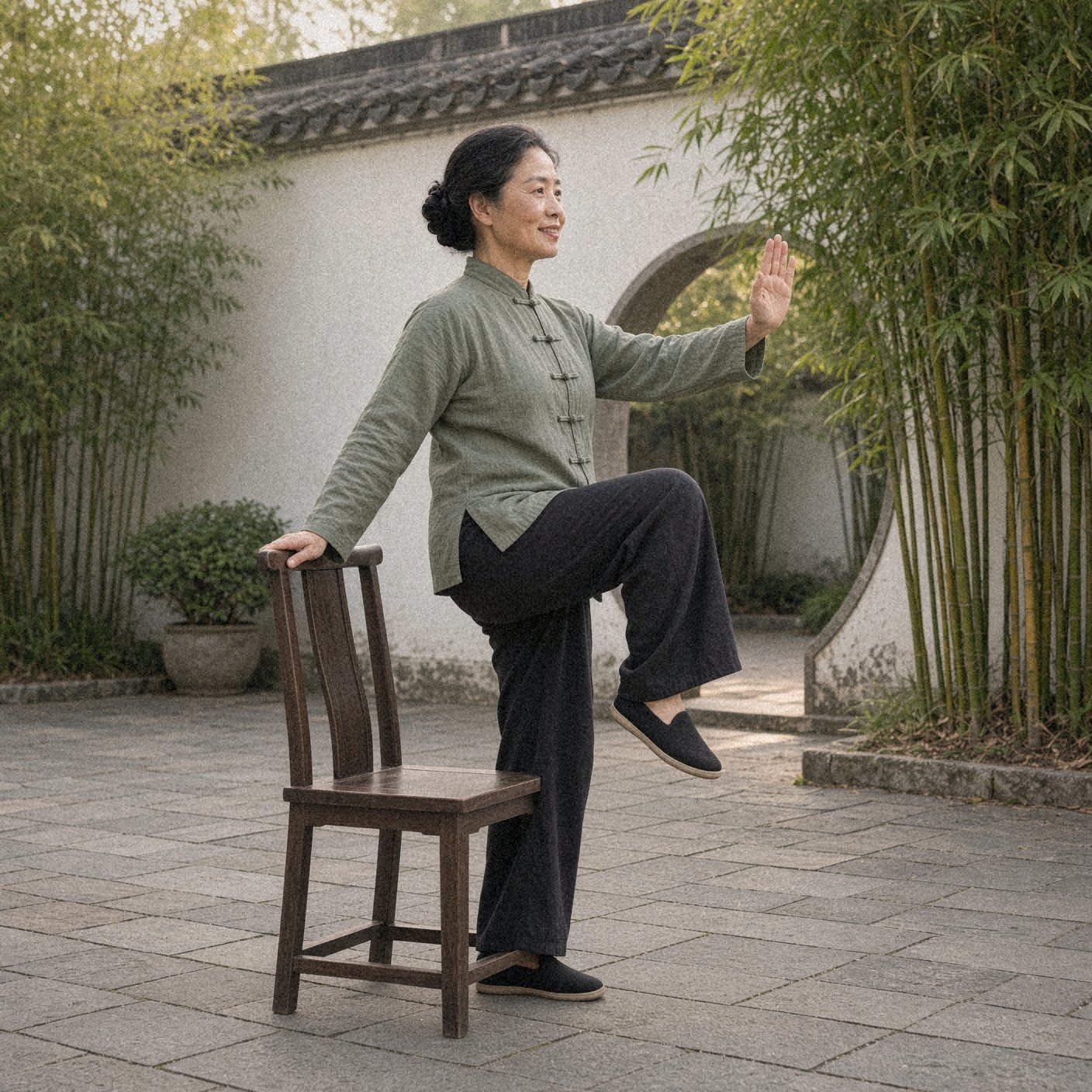
This is a true one leg balance, so always do it near something you can hold.
What the name means: You stand tall on one leg like a rooster, with one knee and the same side hand raised.
How to do it:
- Stand next to a sturdy chair and hold it with one hand.
- Shift your weight onto the leg nearest the chair.
- Lift the other knee a little and raise the same side hand, as in the photo. Hold, then lower slowly.
Make it easier: Lift only your heel and keep your toes on the floor.
How much: Hold for 3 to 5 seconds, 3 times each side.
Step by step help is in our tai chi for beginners guide.
13. Fair Lady Works the Shuttles
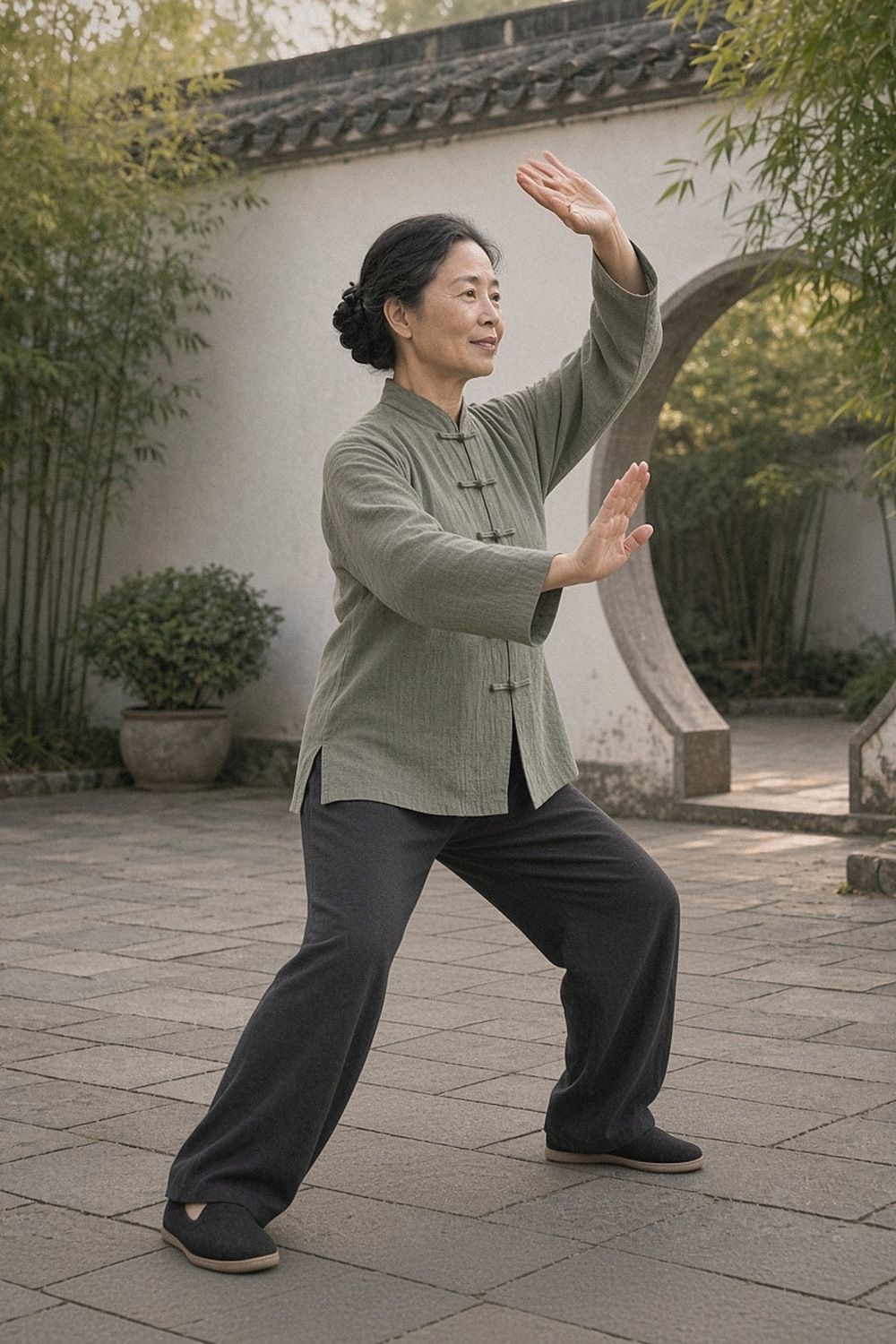
It combines a step, a turn and two arm movements, so it is a good move to add once the basics feel easy.
What the name means: The arms copy a weaver passing a shuttle through a loom, one hand high and one hand forward.
How to do it:
- Step one foot forward at an angle and shift your weight onto it.
- Raise one forearm above your forehead, palm turned out.
- Push the other palm slowly forward at chest height, as in the photo.
Make it easier: Keep your top hand at forehead height or lower, and take a short step.
How much: 2 to 4 times each side.
14. Closing Form
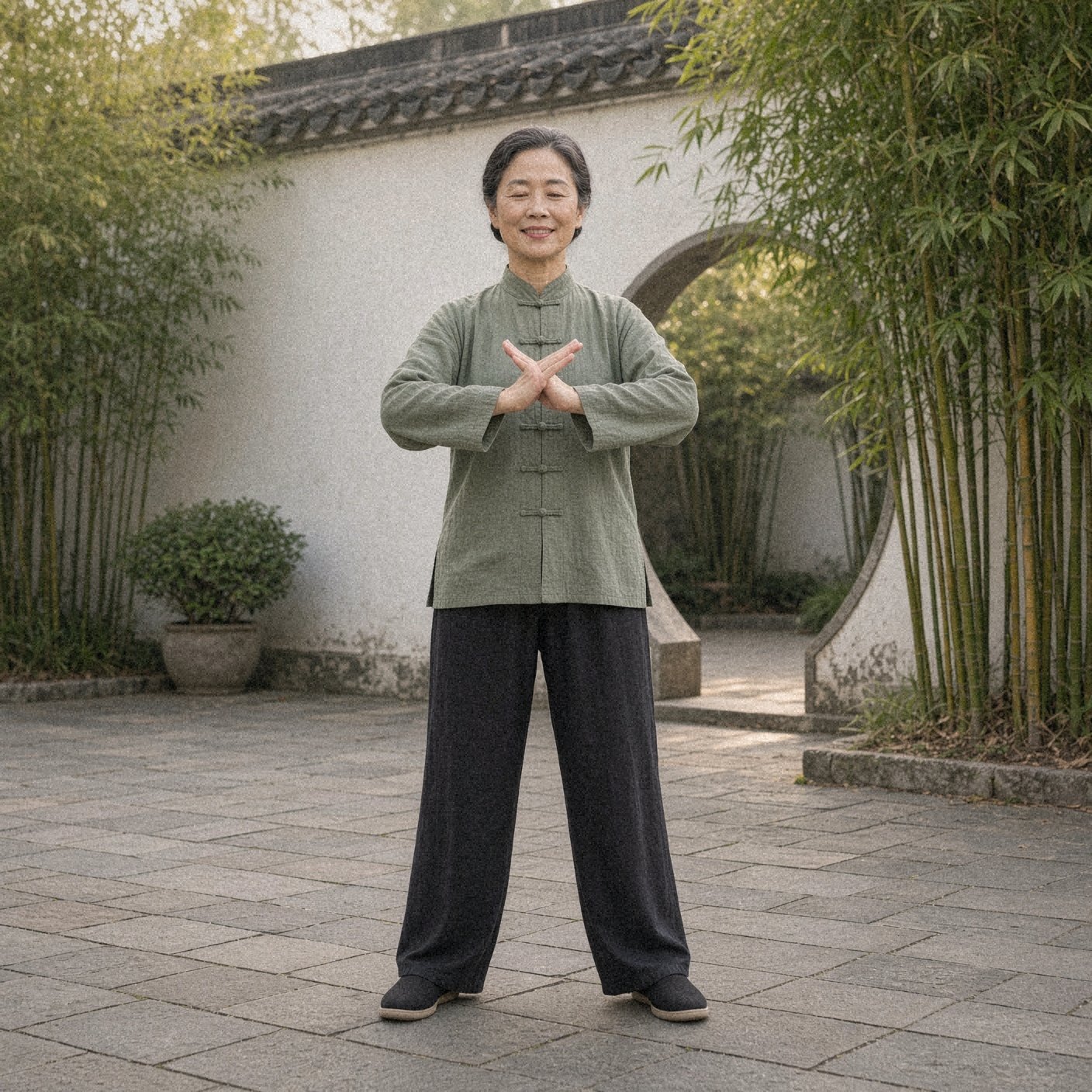
Finishing slowly lets your breathing and heart rate settle before you go back to your day.
What the name means: The way a form ends. Your hands cross in front of you and float down as you stand still.
How to do it:
- Stand with your feet shoulder width apart.
- Cross your wrists loosely in front of your chest, as in the photo.
- Breathe out slowly as your hands open and float down to your sides.
Make it easier: Do it seated, or simply lower your hands with a long breath out.
How much: 3 slow breaths.
How the moves link together
In a class you will rarely do one move on its own. Moves flow into each other, often through Hold the Ball. Many short forms begin with Commencing Form, move on to Part the Wild Horse’s Mane and White Crane Spreads Wings, and end with Closing Form.
Ward Off and Push are two parts of a longer move called Grasp the Bird’s Tail. In between, there are two more parts, often called Roll Back and Press, which are best learned from a teacher or video.
If you practise at home, you can make your own short set. For example: Tai Chi Breathing, Commencing Form, Hold the Ball, Wave Hands Like Clouds and Closing Form. That takes about 5 minutes and uses only easy moves.
How to learn these moves over 4 weeks
Do not try to learn all 14 at once. Add a few each week and keep practising the ones you know.
| Week | What to do |
|---|---|
| Week 1 | Tai Chi Breathing, Commencing Form, Hold the Ball and Closing Form. |
| Week 2 | Add Wave Hands Like Clouds and Part the Wild Horse’s Mane. |
| Week 3 | Add White Crane Spreads Wings, Brush Knee, Ward Off and Push. |
| Week 4 | Add Repulse the Monkey, Single Whip, Golden Rooster and Fair Lady Works the Shuttles, holding a chair for the balance moves. |
When to check with your doctor
Tai chi is gentle, but check with your doctor or physical therapist before you start if any of these apply to you:
- You have had a fall, or you often feel unsteady.
- You have a joint replacement, or knee, hip or back pain.
- You have osteoporosis or a heart condition.
- You take medicines that can make you dizzy or lightheaded.
- You have had recent surgery.
Frequently asked questions
What are the basic tai chi moves?
Good first moves are Tai Chi Breathing, Commencing Form, Hold the Ball, Wave Hands Like Clouds and Closing Form. They are slow, use small steps and appear in most beginner classes.
What are the five tai chi exercises?
There is no single official list of five. If you want five to start with, try the five above. Together they make a short, calm set you can do in about 5 minutes.
What are 10 basic tai chi moves for beginners?
Our tai chi for beginners guide teaches 10 easy moves step by step, with a 10 minute routine you can follow.
Does tai chi build muscle?
It can build some strength. Harvard Health says tai chi “can improve both lower-body strength and upper-body strength.” It will not build big muscles like weight training, but holding soft, bent knee stances does work your legs.
Can tai chi help with belly fat?
No exercise burns fat from one spot. Tai chi is a gentle activity, so it can be part of an active life, but on its own it is not a quick way to lose belly fat. Pair it with regular walking and healthy eating.
Do you need a mat for tai chi?
No. Tai chi is done standing, so you just need a clear, flat space. Harvard Health says you can practise “barefoot or in lightweight, comfortable, and flexible shoes.”
Why is tai chi so difficult?
Most moves are simple on their own. What feels hard at first is moving slowly, remembering the order and keeping your arms and legs working together. Learning a few moves at a time makes it much easier.
Want a one page version? Get our free mini tai chi chart with 5 easy moves and clear photos. Download the free chart.
Keep going
New to tai chi? Start with our tai chi for beginners guide, which has a 10 minute routine. If standing is hard, try chair tai chi. For practice that focuses on steadiness, see tai chi for balance, and if you are over 65, read tai chi for seniors. Back to our guide to gentle exercise.

Written by June Ashby
June writes the Limber Years guides to posture, tai chi, mobility and gentle strength for people over 50. She keeps every routine short, gentle and easy to follow at home. June is not a doctor or physical therapist, so please check with yours before starting something new. More about Limber Years
Sources
This article is general information, not medical advice. Read our full disclaimer.