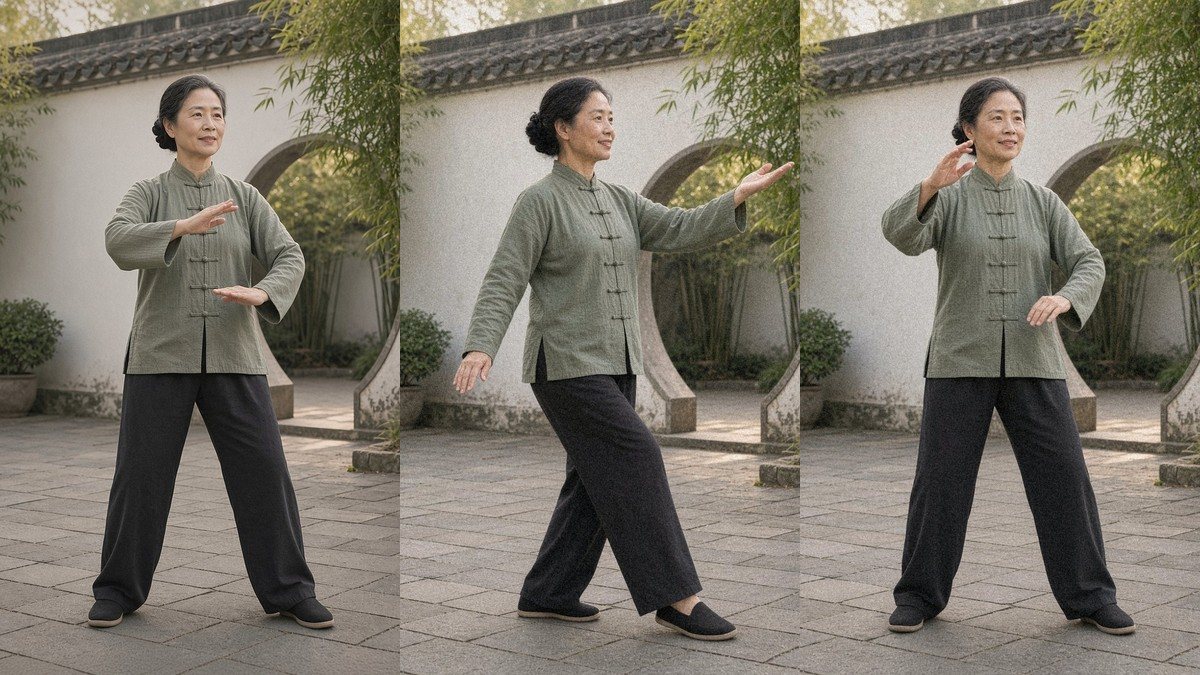
Tai chi and yoga are often mentioned together. Both are slow, both use the breath and both are popular with people over 50. So which one should you choose?
The honest answer is that it depends on what you want and what your body needs. Tai chi is usually the better pick for balance and for people who would rather stay off the floor. Yoga usually does more for flexibility.
This guide compares them side by side and then helps you choose for your own situation.
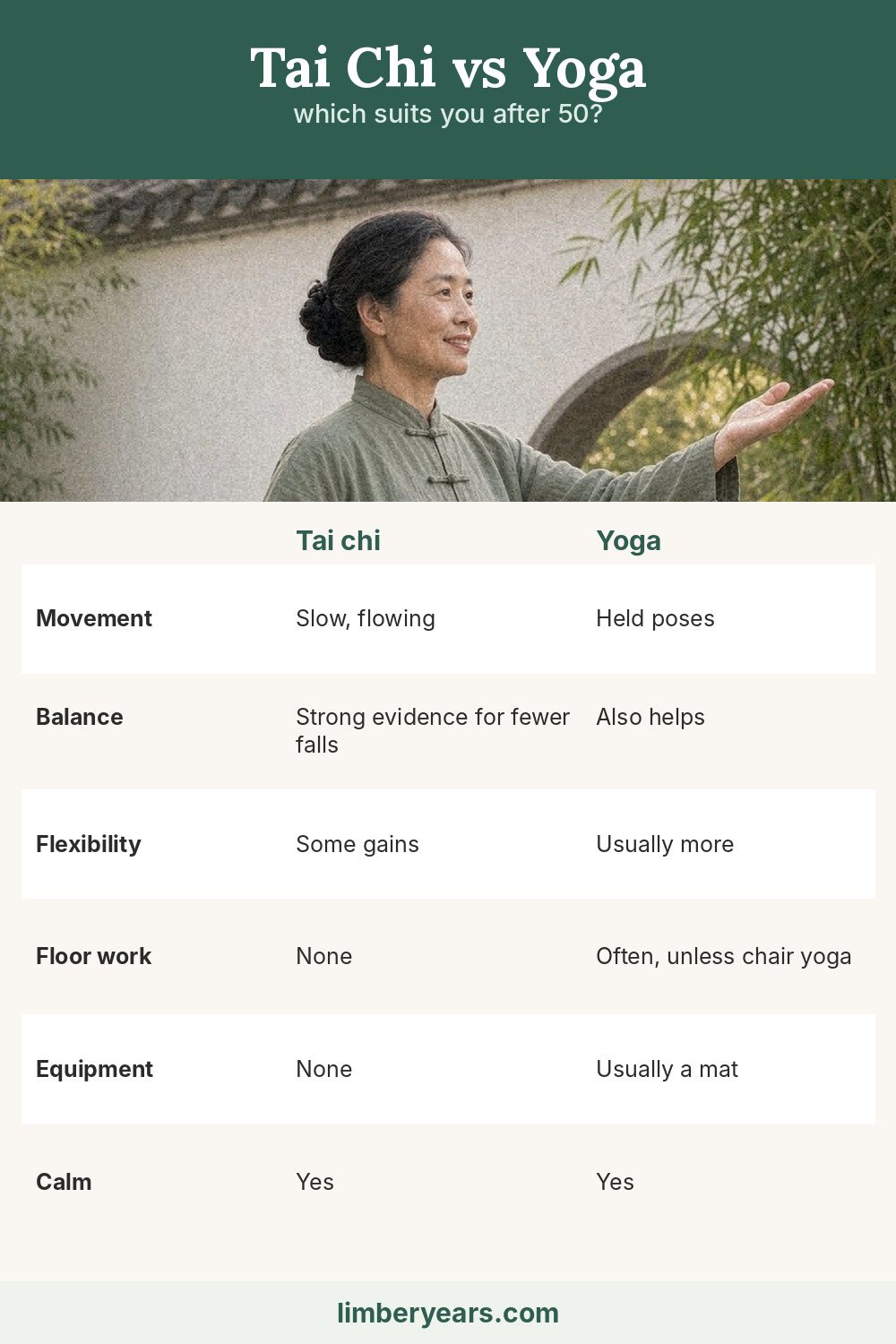
Save this chart to Pinterest to help you choose. Photos on this site are made with AI to show each move clearly.
Key takeaways
- Tai chi is a flowing sequence done standing or seated. Yoga is mostly held poses, often on a mat.
- Tai chi has strong evidence for balance and falls in older adults. Yoga also helps balance and does more for flexibility.
- Tai chi needs no floor work. Many yoga classes include getting down to and up from the floor.
- Both are safe for most people when done gently, ideally with a teacher at first.
What is the main difference?
The National Center for Complementary and Integrative Health (NCCIH) describes each one like this:
Tai chi is a practice that involves a series of slow gentle movements and physical postures, a meditative state of mind, and controlled breathing.
NCCIH: Tai chi, what you need to know
Although classical yoga also includes other elements, yoga as practiced in the United States typically emphasizes physical postures (asanas), breathing techniques (pranayama), and meditation (dyana).
NCCIH: Yoga, effectiveness and safety
They sound similar, but they feel very different. In tai chi you are almost always moving, flowing slowly from one move to the next while standing. In yoga you usually move into a pose, hold it for a few breaths, then move to the next, often on a mat on the floor.
Tai chi vs yoga side by side
| Tai chi | Yoga | |
|---|---|---|
| How you move | Slow, continuous flow | Poses held for a few breaths |
| Where | Standing or seated | Standing, seated and on the floor |
| Equipment | None | Usually a mat, sometimes blocks or straps |
| Balance | Strong evidence for fewer falls in older adults | Also helps balance |
| Flexibility | Some gains | Usually more |
| Strength | Gentle leg strength | Can be gentle or quite hard, depending on the style |
| Getting up and down from the floor | Not needed | Often part of class, but chair yoga avoids it |
| Calm and focus | Yes | Yes |
For the full evidence on tai chi, see our tai chi benefits guide.
Which is better for balance?
Both can help. The National Institute on Aging says “Yoga, Pilates, and tai chi can all improve balance and muscle strength.”
Tai chi has the stronger research for older adults. NCCIH reports high-certainty evidence that tai chi “may reduce the number of people who experience falls by 20 percent.” For yoga, NCCIH notes that most studies in a 2014 review “showed improvements in at least one outcome related to balance” in healthy people.
So if balance or fear of falling is your main concern, tai chi is a very good place to start.
Which is better for flexibility?
Yoga usually wins here, because you hold stretches for several breaths. Tai chi does help too. Harvard Health says it “can boost upper- and lower-body flexibility as well as strength,” but its moves are not designed as deep stretches.
Which is safer?
Both are safe for most people. NCCIH says “Tai chi appears to be safe.” For yoga, it says yoga “is generally considered a safe form of physical activity for healthy people when performed properly, under the guidance of a qualified instructor.”
NCCIH also gives a caution for older adults: “The rate of yoga-related injuries treated in emergency departments is higher in people age 65 and older than in younger adults.” It advises new students to avoid extreme practices “such as headstands, shoulder stands, the lotus position, and forceful breathing.” Gentle or chair yoga is a better fit for most people over 50.
How to choose for your situation
| If you | Try |
|---|---|
| You worry about falling or feel unsteady | Tai chi, starting with a chair nearby |
| Getting down to the floor is hard | Tai chi, or chair yoga |
| You feel stiff and want to loosen up | Yoga, a gentle class |
| You have osteoporosis | Ask your doctor. Tai chi is often a comfortable choice; avoid yoga poses that round or twist the spine hard |
| You have a new hip or knee | Ask your surgeon or physical therapist which moves are safe for you |
| You want something calming | Either. Try a class of each and see which you enjoy |
| You use a walker or wheelchair | Chair tai chi or chair yoga |
The best choice is the one you will keep doing. Try one class of each before you decide.
What about Pilates?
Pilates is another popular choice. It focuses on core strength and control, often on a mat or a machine. It can be a good fit if you want to strengthen your middle body, but most mat classes involve the floor. Tai chi is usually the gentler starting point if balance is your main goal.
A sample week that uses both
You do not have to choose just one. Here is one way to mix them with walking.
| Day | What to do |
|---|---|
| Monday | Tai chi, 15 minutes |
| Tuesday | Walk, 20 to 30 minutes |
| Wednesday | Gentle or chair yoga, 20 minutes |
| Thursday | Walk, 20 to 30 minutes |
| Friday | Tai chi, 15 minutes |
| Saturday | Walk or rest |
| Sunday | Rest, or a short stretch |
When to check with your doctor
Both are gentle when done the right way, but check with your doctor first if any of these apply to you:
- You have osteoporosis or a past spine fracture.
- You have a hip or knee replacement.
- You have high blood pressure or glaucoma (some yoga poses put your head below your heart).
- You have had a fall or often feel dizzy.
- You have back or neck pain.
Frequently asked questions
Which is better for older people, tai chi or yoga?
For balance and avoiding falls, tai chi has the stronger evidence in older adults and needs no floor work. For flexibility, yoga usually does more. Many people enjoy doing both.
Is tai chi a type of yoga?
No. Tai chi comes from China and grew out of martial arts. Yoga comes from India. They share slow movement, breathing and focus, but they are separate practices.
Which burns more calories, tai chi or yoga?
It depends on the style. Gentle yoga and tai chi are both light activities. Faster, harder styles of yoga burn more. For weight loss, walking is often the simplest choice.
Can I do tai chi and yoga on the same day?
Yes. They are both gentle. Many people do a short tai chi session in the morning and some gentle stretching or yoga later in the day.
Do you need a mat for tai chi?
No. Tai chi is done standing or seated, so you only need a clear, flat space and flat shoes.
Keep going
Want to try tai chi? Start with tai chi for beginners or, if you prefer to sit, chair tai chi. For the evidence behind each benefit, see tai chi benefits, and if you are over 65, read tai chi for seniors. Back to our guide to gentle exercise.

Written by June Ashby
June writes the Limber Years guides to posture, tai chi, mobility and gentle strength for people over 50. She keeps every routine short, gentle and easy to follow at home. June is not a doctor or physical therapist, so please check with yours before starting something new. More about Limber Years
Sources
- NCCIH: Tai chi, what you need to know
- NCCIH: Yoga, effectiveness and safety
- NIA: Falls and fractures in older adults
- Harvard Health: The health benefits of tai chi
This article is general information, not medical advice. Read our full disclaimer.