
Search for tai chi benefits and you will find long lists. Better balance, less pain, lower blood pressure, better sleep, less stress. Some of these are well supported. Others rest on small or weak studies.
This page goes through the main benefits one by one and tells you honestly how strong the evidence is, using the National Center for Complementary and Integrative Health (NCCIH) and Harvard Health as our main sources.
There are no exercise instructions here. If you want to start, the links at the end will take you to our step by step guides.
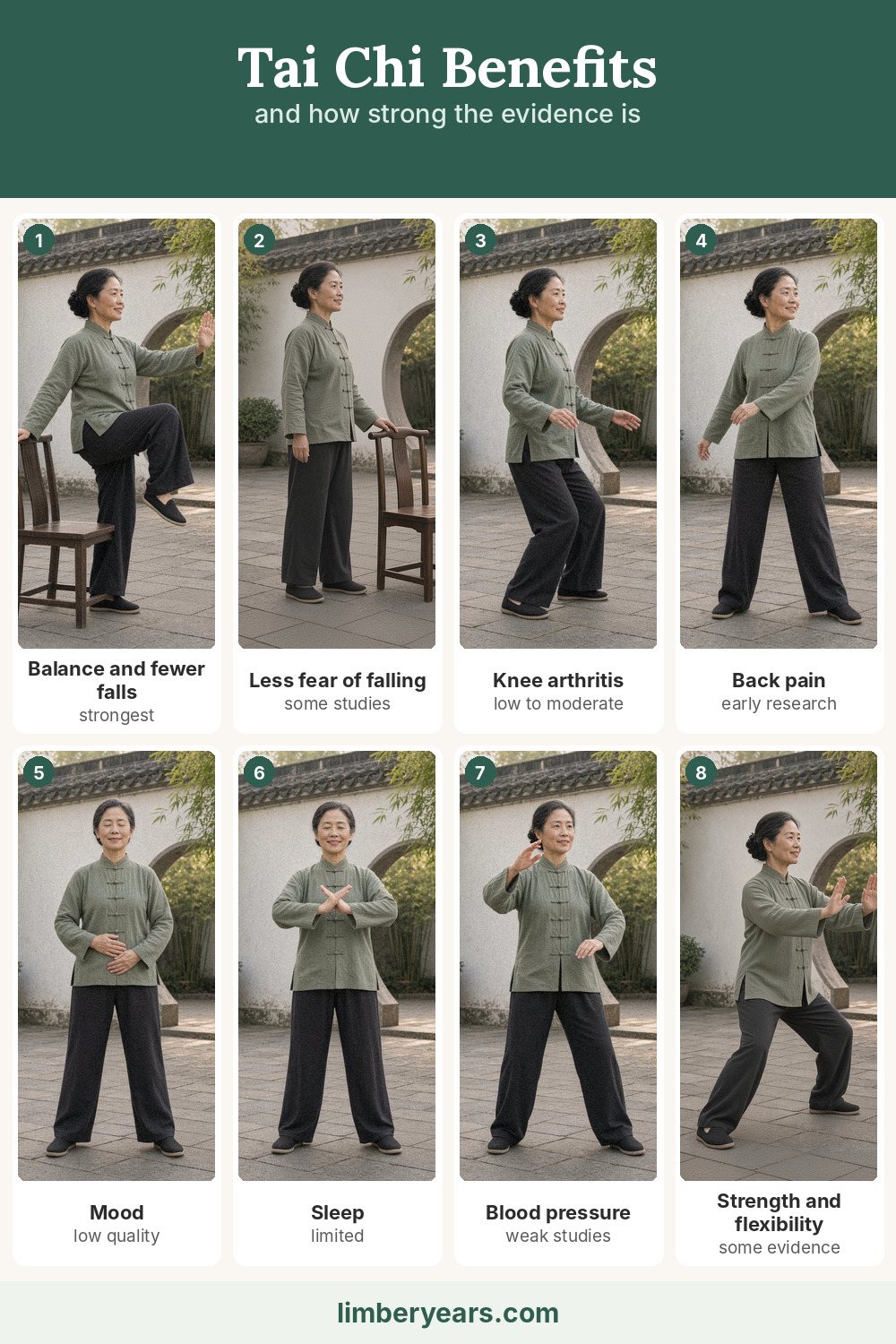
Save this chart to Pinterest as a quick summary of what the research says. Photos on this site are made with AI to show each move clearly.
Key takeaways
- The strongest evidence is for balance and falls in older adults.
- There is some evidence for knee osteoarthritis pain, and smaller, weaker evidence for back pain, mood, sleep and blood pressure.
- Tai chi can also build gentle strength and flexibility.
- It is very safe for most people, which is a benefit in itself.
Tai chi benefits at a glance
| Benefit | What the research found | How strong |
|---|---|---|
| Balance and falls in older adults | Fewer people fall | Strongest |
| Fear of falling | Some studies show less fear | Some |
| Knee osteoarthritis | Helps with pain and managing it | Low to moderate |
| Back pain and fibromyalgia | May reduce pain | Small amount of research |
| Mood and quality of life | Small positive effect | Low quality |
| Sleep | Better sleep in people with fibromyalgia | Limited |
| Blood pressure | Lower readings in studies | Poor quality studies |
| Strength and flexibility | Gentle gains in upper and lower body | Some |
1. Balance and fewer falls
This is where tai chi has the best evidence. NCCIH says it “may be beneficial in improving balance and preventing falls in older adults and people with Parkinson’s disease.”
Compared to control interventions that were not thought to reduce falls, there was low-certainty evidence that tai chi may reduce the rate of falls by 19 percent (based on 7 studies with 2,655 participants) and high-certainty evidence that tai chi may reduce the number of people who experience falls by 20 percent (based on 8 studies with 2,677 participants).
NCCIH: Tai chi, what you need to know
How strong: strong for the number of people who fall, weaker for the total number of falls. See our tai chi for balance guide for drills to practise.
2. Less fear of falling
Being afraid of falling can make people move less, which makes them weaker and less steady. Harvard Health says “Fear of falling can make you more likely to fall; some studies have found that tai chi training helps reduce that fear.”
How strong: some studies, not a firm conclusion.
3. Knee osteoarthritis
NCCIH reports that “A 2021 review of 16 studies involving 986 participants found evidence of low-to-moderate strength that tai chi was beneficial for treating and managing knee osteoarthritis.”
How strong: low to moderate. Many people with sore knees find tai chi comfortable because the steps are small and the knees stay soft. Keep stances short and high.
4. Back pain and fibromyalgia
NCCIH says “A small amount of research suggests that tai chi may be helpful in reducing pain in people with low-back pain, fibromyalgia, and knee osteoarthritis.”
How strong: early and small. If you have back pain, ask your doctor or physical therapist first, and avoid twisting hard.
5. Mood and quality of life
NCCIH describes a 2020 review of 13 studies that “found that tai chi had a small positive effect on the quality of life and depressive symptoms of older adults with chronic conditions who lived in community settings.” But it adds that “the evidence was of low quality, and that larger high-quality studies are needed.”
How strong: low quality. Many people say tai chi feels calming, and that is a good reason to try it, but it is not a treatment for depression.
6. Sleep
In a review of tai chi for people with fibromyalgia, NCCIH reports that “Tai chi also helped to improve sleep quality, relieve fatigue, reduce depression, and increase quality of life.” The review authors said larger, better studies are needed.
How strong: limited, and mostly in people with fibromyalgia. We cannot say it improves sleep for everyone.
7. Blood pressure and heart health
NCCIH describes a 2020 review of 28 studies that found tai chi “was better at lowering systolic and diastolic blood pressure than health education/no treatment, other exercises, or antihypertensive drugs.” However, “the authors said the studies were of poor quality.”
How strong: poor quality studies. Never stop blood pressure medicine because you have started tai chi. Harvard Health also notes that tai chi “can provide some aerobic benefits” depending on the speed and size of the movements, but it may not replace brisker exercise if your doctor has advised it.
8. Strength and flexibility
Harvard Health says “Tai chi can improve both lower-body strength and upper-body strength” and that it “can boost upper- and lower-body flexibility as well as strength.”
How strong: some evidence. Do not expect big muscles, but the soft, bent knee stances do work your legs.
What about memory, bones and stress?
- Memory and thinking: NCCIH describes a 2023 study of 318 older adults with mild memory problems where a version of tai chi mixed with thinking tasks led to improvements in cognition. It is one study, so treat it as promising, not proven.
- Bones: we did not find strong evidence in our main sources that tai chi makes bones stronger, so we do not claim it. If you have osteoporosis, ask your doctor which exercises are best for you.
- Stress: most people find the slow moves and breathing relaxing. That is a real benefit even without big studies behind it.
Is tai chi safe?
For most people, yes. NCCIH says “Tai chi appears to be safe,” and Harvard Health calls it “very safe.” That matters. An exercise you can do for years without getting hurt often does more good than a harder one you stop after a month.
What happens if you do tai chi every day?
There is no magic in daily practice, but regular practice is how the benefits build up. Here is a realistic picture:
- First few weeks: you learn the moves, feel calmer during practice and may notice you stand a little taller.
- After about 3 months: this is the length of most research programs. Harvard Health notes that most beginner programs tested in research “last at least 12 weeks.” Many people feel steadier on their feet by this point.
- Over the long term: tai chi becomes a habit that keeps you moving, which is good for almost every part of your health.
Tai chi and qigong: what is the difference?
Qigong (say chee gung) is a related Chinese practice that also combines gentle movement, breathing and focus. Qigong exercises are often simple moves repeated several times, while tai chi links many moves into a flowing sequence called a form. Both are gentle, and many classes teach a little of each.
When to check with your doctor
Tai chi is gentle, but it does not replace medical care. Talk to your doctor before starting if any of these apply to you:
- You have a heart or lung condition, or high blood pressure that is not controlled.
- You have had a fall, or you often feel dizzy.
- You have a joint replacement or ongoing back, hip or knee pain.
- You have osteoporosis.
- You take medicines that can make you dizzy or lightheaded.
Frequently asked questions
What are the main benefits of tai chi?
The best supported benefit is better balance and fewer falls in older adults. There is also some evidence for knee osteoarthritis pain and for gentle strength and flexibility, and weaker evidence for mood, sleep and blood pressure.
Can tai chi help with back pain?
Possibly. NCCIH says a small amount of research suggests tai chi may help reduce pain in people with low back pain. Talk to your doctor or physical therapist first and avoid twisting hard.
Is tai chi good for weight loss?
Tai chi is a gentle activity, so on its own it burns fewer calories than brisk walking. It can be part of an active life, but it is not a quick weight loss plan.
Is tai chi a religion?
Tai chi has roots in Chinese martial arts and Chinese philosophy, but most classes in the US and UK teach it simply as exercise, with no religious practice. If this matters to you, ask the teacher how they teach it.
What is tai chi walking?
It is a slow, careful way of walking that uses tai chi steps: sink into one leg, place the heel, then roll forward. Our tai chi walking guide shows it step by step.
Is tai chi or walking better?
They are different. Walking is better for your heart and lungs. Tai chi adds slow balance practice. Doing both gives you the best of each.
Want a one page version? Get our free mini tai chi chart with 5 easy moves and clear photos. Download the free chart.
Keep going
Ready to try it? Start with our tai chi for beginners guide, or chair tai chi if you prefer to sit. Our tai chi walking guide is another easy way in. For balance practice, see tai chi for balance, and if you are deciding between practices, read tai chi vs yoga. Back to our guide to gentle exercise.

Written by June Ashby
June writes the Limber Years guides to posture, tai chi, mobility and gentle strength for people over 50. She keeps every routine short, gentle and easy to follow at home. June is not a doctor or physical therapist, so please check with yours before starting something new. More about Limber Years
Sources
This article is general information, not medical advice. Read our full disclaimer.